Asian Flush Headaches: Why Alcohol Triggers Them and How to Reduce Them

Share this article
Copy and paste this link
Few things ruin a good night out like a headache that sets in while you're still holding your drink — the kind that throbs harder every time you turn your head. Plenty of people write it off as a normal part of drinking. But if you go red in the face when you drink and the headache turns up early, often after just a glass or two, you may be dealing with something more specific than an ordinary hangover: an Asian flush headache.
This kind of headache isn't really about how much you drank. It's tied to how your body handles a toxic by-product of alcohol called acetaldehyde — and it usually arrives alongside the other hallmarks of the alcohol flush reaction: a red face, a faster heartbeat, and sometimes nausea. Below we'll walk through why it happens, what genuinely helps, and — just as importantly — what only hides it.
Why alcohol gives you a headache (and why Asian flush makes it worse)
When you drink, your liver breaks ethanol down in two steps. First, an enzyme called alcohol dehydrogenase (ADH) turns it into acetaldehyde, a compound considerably more toxic than the alcohol itself. Then a second enzyme, ALDH2, is meant to convert that acetaldehyde into harmless acetate.
If you have ALDH2 deficiency — a genetic variant common in people of East Asian descent — that second step runs slowly, so acetaldehyde piles up instead of being cleared. As it accumulates, it widens blood vessels and drives inflammatory signalling, including in the vessels around the brain. Cleveland Clinic notes this build-up is what produces the flushing, rapid heartbeat and headache that can show up after very little alcohol. Ethanol is also a vasodilator in its own right, which is why even people without the variant can get a throbbing, vascular-feeling headache.
In ALDH2 deficiency, the headache is driven by acetaldehyde building up faster than your body can clear it.
The drink itself matters too. Darker drinks — whiskey, brandy, red wine — carry more congeners, by-products of fermentation and ageing that can worsen headaches, and red wine and champagne are also higher in histamine. If you want the deeper dive on specific drinks, we've covered beer headaches separately.
How common are Asian flush headaches?
Common enough that if this is you, you're far from alone. In a reader survey we ran on the alcohol flush reaction, around half of respondents said they get headaches after drinking — the second most reported symptom, behind facial redness, which nearly everyone reported. Plenty described getting both together. (That's our own survey data rather than a clinical study, but it lines up with what the biology predicts.)
What actually helps — and what only hides it
This is the part worth slowing down for. Some approaches reduce how much acetaldehyde your body has to deal with. Others simply switch off the warning signs — the flush, the headache — while the acetaldehyde keeps accumulating underneath. The difference matters, because the symptoms are information, not just an inconvenience.
Masking the warning signs is the risky part — it lets you keep drinking while the toxic load quietly rises.
Reduce how much acetaldehyde you make
The single most reliable lever is also the least glamorous: drink less, and drink more slowly. Your ALDH2 enzyme can only work at the pace it works at, so giving it time helps. Taking 30–40 minutes over a standard drink, alternating with water, and eating beforehand all reduce how fast acetaldehyde accumulates — which directly softens the headache. There's no supplement or trick that outperforms simply slowing down.
Support your body's acetaldehyde clearance
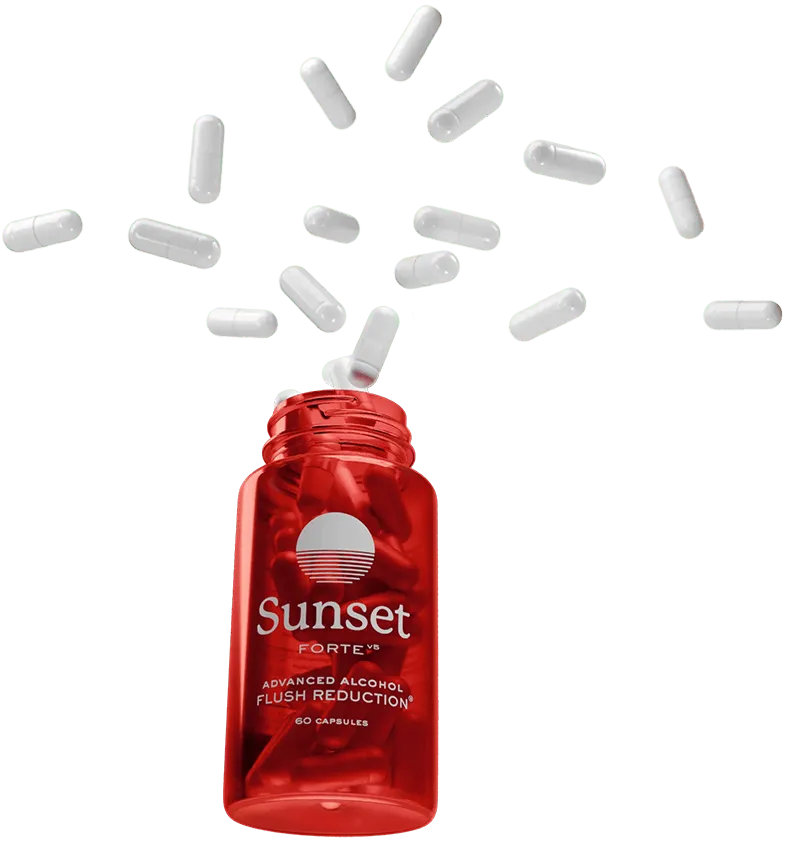
Because the headache traces back to that ALDH2 bottleneck, some people use a supplement aimed at the metabolic step itself. Sunset Alcohol Flush Support is formulated around well-studied ingredients — NAC, S-acetyl glutathione, DHM, L-theanine and B vitamins — chosen to support the body's natural acetaldehyde clearance rather than to numb the symptoms. NAC, for instance, supports production of glutathione, an antioxidant your body uses in processing acetaldehyde. It isn't a cure and it won't make alcohol harmless, but supporting clearance is a fundamentally different approach from masking the signal. If you want the underlying biochemistry, we've laid out the ways people try to break down acetaldehyde, and the broader picture of why drinking can stop agreeing with you in our guide to alcohol intolerance.
Stay hydrated
Alcohol is a diuretic, so it nudges you toward dehydration — and dehydration alone can cause or worsen a headache. Hydration won't fix an acetaldehyde-driven headache on its own, but it removes one compounding factor. A rough, slightly unglamorous gauge: aim to keep your urine pale rather than dark before and during drinking. Alternating each drink with a glass of water is the easy version.
Be careful with antihistamines and antacids (Pepcid, Zantac, Zyrtec)
It's common for people with Asian flush to take heartburn or allergy medication before drinking to switch off the redness — and the headache often quiets down too. The problem is that these drugs only blunt the symptoms; they do nothing about the acetaldehyde causing them. Cleveland Clinic warns that masking the signs of alcohol intolerance this way can lead people to drink more than they otherwise would, which makes the underlying problem worse, not better. And the underlying problem is serious: acetaldehyde is a recognised carcinogen, which is exactly why quietly suppressing the warning to keep drinking is a genuinely risky habit. We go into the specifics in our pieces on Pepcid, Zantac and Zyrtec for Asian flush and on the Asian flush cancer risk. This isn't a tip — it's a caution.
What about vitamin C?
You'll see vitamin C suggested a lot, and there is some science behind the idea: a small, older human study found that taking vitamin C before drinking reduced acetaldehyde-related toxicity in the blood. But it was a handful of participants, it's decades old, and it doesn't establish vitamin C as a reliable fix for headaches. Treat it as a maybe-helpful extra, not a solution — and not a substitute for drinking less.
When a headache is a warning, not just an annoyance
Most drinking headaches are unpleasant but harmless. Some are not. See a doctor if a headache after alcohol is sudden and severe, is the worst you've ever had, comes with confusion, a stiff neck, fainting or chest pain, or if headaches are becoming more frequent or intense over time. And please don't use makeup, medication or any other trick to mask the flush and headache so you can keep drinking — the reaction is your body flagging that it's struggling to clear a toxin, and that signal is worth listening to.
The bottom line
An Asian flush headache isn't a personal failing or a low tolerance — it's acetaldehyde building up faster than your body can clear it. The things that genuinely help work on that cause: drinking less and more slowly, staying hydrated, and supporting your body's natural clearance. The things to be wary of are the ones that simply hide the signal. If you flush and ache after even a small amount of alcohol, that's useful information — not something to paper over.
Want to keep reading? We cover the two-day hangover, hangover anxiety, and whether Pedialyte helps after drinking elsewhere on the blog — and if you're not sure whether what you're experiencing is flush, intolerance or something else, start with our alcohol intolerance guide.
Enjoy your social life again — get Sunset Alcohol Flush Support for
33% off while stocks last!
What's inside?
Sunset Forte uses a carefully formulated blend of Glutathione, Dihydromyricetin, Cysteine, L-Theanine, & B Vitamins to support natural acetaldehyde processing and a clearer, less-flushed look.
Learn more
94% of people who try Sunset are satisfied.