Sudden Alcohol Intolerance: When One Drink Suddenly Feels Like Too Much

⏱️ TL:DR ∙ Article in 20s
Sudden alcohol intolerance is when you used to tolerate alcohol but now even small amounts trigger symptoms within minutes — flushing, nausea, a racing heart or hives. It rarely means a brand-new disease; usually something changed — your health, a new medication, or an ingredient in a specific drink rather than the alcohol itself. Red flag: trouble breathing, swelling, fainting or chest pain can signal anaphylaxis — stop drinking and get urgent help. Otherwise, stop "testing" it, track your drinks and symptoms for a couple of weeks, and see a clinician.
- A quick note
- What is sudden alcohol intolerance?
- Symptoms
- Red flags
- Why it happens
- What to do next
- Conclusion
Share this article
Copy and paste this link
Think back to the last time alcohol felt… normal. Not "perfect," not "healthy," just predictable. You knew what a glass of wine would do, how a beer would land.
And then — sometimes over a single weekend — it changes.
One drink and your face lights up hot and red. Your heart races. You feel nauseous, maybe your chest tightens, maybe you break out in hives.
The unsettling part usually isn't the symptom. It's the newness of it.
That pattern — alcohol you used to handle suddenly turning on you — is what people mean by sudden alcohol intolerance. And the most useful thing to understand is that it's rarely a brand-new disease. It's almost always a signal that something else changed.
This guide walks through what that something might be, and what to do about it.
If you’re wondering whether that’s even possible — can you really develop alcohol intolerance after years of drinking without issue? — the short answer is yes, and it’s more common than most people realise.
A quick note up front
If you ever have trouble breathing, swelling of the lips, face or throat, severe hives, chest pain, fainting, or a "something is seriously wrong" feeling after drinking, treat it as urgent and seek emergency care. Severe reactions can be life-threatening, and the Mayo Clinic warns that signs like a weak pulse, vomiting or trouble breathing can point to anaphylaxis.
For milder-but-repeatable reactions, it's still worth talking to a clinician — because, as the Mayo Clinic notes, sudden intolerance can be a sign that something has shifted in your health, your medications, or your triggers.
What is sudden alcohol intolerance?
Sudden alcohol intolerance is when you've previously been able to drink without much trouble, then start having reliable, unpleasant reactions after small amounts — often within minutes.
The Mayo Clinic describes alcohol intolerance as a usually genetic inability to break down alcohol efficiently, and is blunt about the fix: "The only way to prevent these reactions is to avoid alcohol."
If you want the full picture of how intolerance works as a condition — the enzymes, the mechanisms, the testing — that's covered in our complete guide to alcohol intolerance. This article is about the part that guide doesn't dwell on: why it can appear suddenly.
And when symptoms start out of nowhere, the most useful question isn't "what is it called?" It's "what changed?"
What it feels like
The symptoms themselves aren't unique to sudden onset — flushed skin and warmth, a stuffy nose, nausea, a racing heart, dizziness, hives, or wheezing, usually within minutes of drinking.
The Cleveland Clinic catalogues the same set — nausea and vomiting, flushing, a fast heartbeat, low blood pressure and headache — and the NIAAA notes that the flush reaction can bring far more than facial redness, including hives, nausea, low blood pressure and worsening asthma. (For the full rundown, see the main intolerance guide.)
What makes it sudden is simply that these reactions are new for you — drinks you handled fine a month ago now don't agree with you at all.
Red flags: when it's more than intolerance
Ordinary intolerance is miserable but not usually dangerous. A true allergic reaction is a different animal. As Dr. Raj Dasgupta, a quadruple board-certified physician, puts it: "An alcohol allergy is much rarer but also more serious" — an immune response that can escalate fast. The practical job is telling repeatable discomfort apart from an emergency.
When in doubt, treat swelling or breathing trouble as an emergency, not an inconvenience.
Why would alcohol suddenly "stop agreeing with you"?
Below are the common "why now?" buckets clinicians think about. This isn't a diagnosis — think of it as a map for what to discuss with a doctor.
1) A change in your health
Sudden reactions can track with shifts in liver function (the liver does the heavy lifting in alcohol metabolism), gut health, or hormones. None of these automatically means something dangerous — but they're a reason to get checked if the reaction is new and consistent.
Rarely, a new alcohol reaction can flag something that needs attention on its own: alcohol-induced pain is a recognised, if uncommon, sign of Hodgkin lymphoma. As UCSF oncologist Dr. Babis Andreadis explains, there's "a well-known phenomenon of alcohol-related lymph node enlargement" in people with the disease. It's rare — but it's exactly why a genuinely new, unexplained reaction is worth a conversation rather than a shrug.
2) Medication interactions (and a myth worth clearing up)
Plenty of medications can worsen flushing, nausea, dizziness or sedation with alcohol. The one most people "know" about is metronidazole, long described as causing a disulfiram-like reaction. Interestingly, that classic explanation has been challenged: a 2023 review found controlled experimental data actually refute the idea that metronidazole reliably triggers a disulfiram-like reaction through acetaldehyde buildup, and the British Dental Journal notes the traditional mechanism "now seems to be incorrect" — even though people still report feeling rotten.
The practical takeaway is unchanged: if your symptoms started after a new medication, bring the exact list to your clinician or pharmacist and ask directly.
3) It may not be the alcohol — but what's in the drink
Sometimes the trigger isn't ethanol at all, but something riding along in the glass — histamine (especially in fermented drinks like wine), sulfites (more relevant if you get asthma-like symptoms), or specific grains, yeasts or additives. A 2022 review on histamine intolerance describes a symptom picture — flushing, headache, low blood pressure, a fast heart, GI upset — that overlaps heavily with "alcohol intolerance," and stresses how easily these non-specific symptoms get misattributed. If your reaction looks allergic (hives, swelling, breathing trouble), an ingredient is a more likely culprit than the alcohol itself.
4) Allergy versus intolerance
These get conflated constantly. The Australasian Society of Clinical Immunology and Allergy (ASCIA) is clear that facial flushing after small amounts of alcohol "is not an allergic reaction." Intolerance is a metabolic problem; allergy is an immune one. True allergy to ingredients in a drink can happen and can be dangerous — so if your symptoms involve swelling, breathing difficulty or rapid progression, treat it as urgent. If you're trying to work out which camp you're in, our guide on alcohol allergy versus intolerance goes deeper.
5) Hormones and aging
Tolerance genuinely shifts over time — with body composition, hydration, sleep, stress and metabolism. Hormones matter too: many women notice alcohol hitting harder in their 40s and 50s. Northwestern gynecologist Dr. Lauren Streicher notes that "low estrogen has an impact on alcohol metabolism" — not yet well studied, but a real and common experience. If you're thinking "nothing changed," sometimes the change is gradual until, one night, it isn't.
What to do next: a calm, practical plan
Sudden intolerance is unsettling, but the response is straightforward.
Stop "testing" it with random drinks
If a reaction feels unsafe, don't keep experimenting. The Mayo Clinic's guidance is blunt for a reason: avoid the drinks that trigger symptoms until you've been evaluated.
Track the pattern for 2–3 weeks
Write down what you drank (brand and type), how much, what you ate with it, how long until symptoms, and exactly what happened (skin, breathing, heart, gut, dizziness). Patterns reveal a lot — whether it's all alcohol or specific drinks, fermented drinks versus spirits, with food versus on an empty stomach. A case report in CMAJ lays out how doctors weigh exactly this kind of differential — from ALDH2 and medications through to rarer causes.
Ask your clinician the right questions
Bring your notes and ask plainly: Could this be alcohol-metabolism intolerance, or more likely an ingredient reaction? Do any of my medications interact with alcohol? Do I need evaluation for allergy, asthma, liver function, or something else?
Be cautious about "masking" the symptoms
Some people reach for antihistamines to flatten the flush. The trouble is it creates a false sense of safety and nudges you to drink more than your body tolerates — and the flush can be linked to higher long-term risks in some people.
Stanford's Che-Hong Chen warns it's "actually more dangerous to block the redness." If you're thinking about anything aimed at "pushing through," that's a conversation for a clinician — especially while symptoms are new.
Sudden intolerance is a signal, not a label
If alcohol suddenly started hitting you differently, you're not imagining it.
But "sudden alcohol intolerance" isn't one single condition — it's a pattern: a new reaction to something you used to tolerate. So treat it accordingly. Urgent symptoms mean urgent care. Repeatable symptoms mean a medical evaluation. Don't self-diagnose, and don't mask it and push through.
The reaction is information. The goal is to find out what changed.
References
- Mayo Clinic Staff. Alcohol intolerance — Symptoms & causes.
- Mayo Clinic Staff. Alcohol intolerance — Diagnosis & treatment.
- Cleveland Clinic. Alcohol Intolerance: Symptoms, Tests & Alcohol Allergy.
- NIAAA. Alcohol Flush Reaction: Does Drinking Alcohol Make Your Face Red?
- Feldman R, et al. (2023). Can Metronidazole Cause a Disulfiram-Like Reaction? (PubMed).
- Steel BJ. (2020). Metronidazole and alcohol. British Dental Journal.
- Zhao Y, et al. (2022). Histamine Intolerance—A Kind of Pseudoallergic Reaction (PMC).
- ASCIA. Alcohol allergy.
- Annals, Academy of Medicine, Singapore. (2024). Association between alcohol flushing syndrome and cancer: a systematic review and meta-analysis.
- Hone Health. Is Menopause Making Me Intolerant to Alcohol? (quoting Lauren Streicher, M.D., Northwestern University).
- Fox News. Is your hangover actually alcohol intolerance or an allergy? (quoting Raj Dasgupta, M.D.).
- Stanford Medicine Scope. Cheers to No Alcohol Day (quoting Che-Hong Chen, PhD).
- OncoLink. Alcohol-Related Pain and Hodgkin Lymphoma (quoting Babis Andreadis, MD, MSCE, UCSF).
- Bryant AJ, Newman JH. (2013). Alcohol intolerance associated with Hodgkin lymphoma. CMAJ.
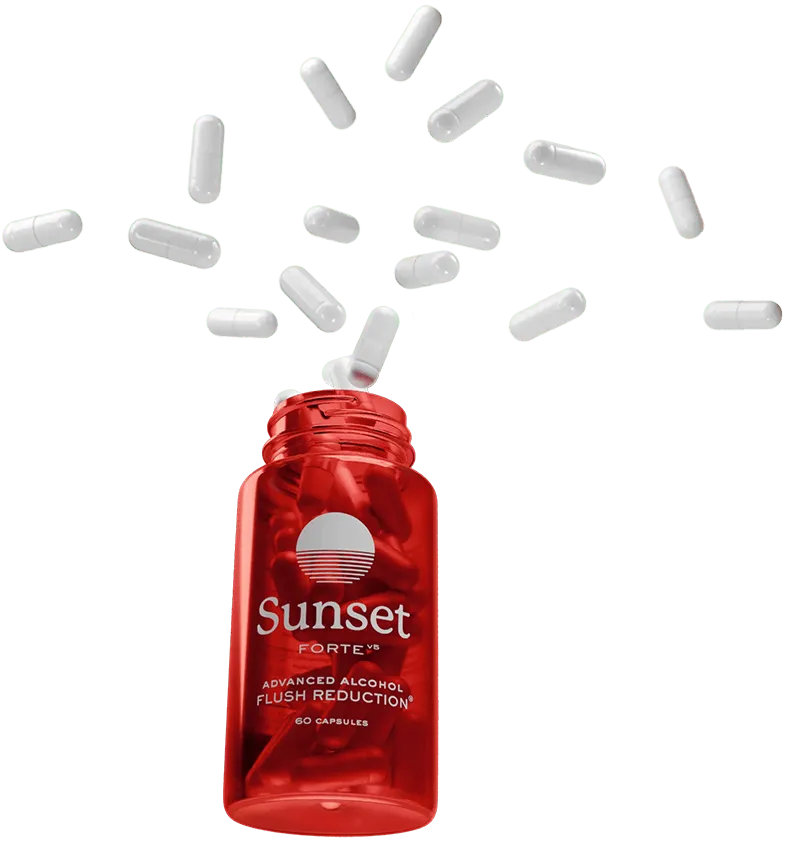
Enjoy your social life again — get Sunset Alcohol Flush Support for
33% off while stocks last!
What's inside?
Sunset Forte uses a carefully formulated blend of Glutathione, Dihydromyricetin, Cysteine, L-Theanine, & B Vitamins to support natural acetaldehyde processing and a clearer, less-flushed look.
Learn more
94% of people who try Sunset are satisfied.