Why Your Face Turns Red When You Drink: The Science of Flushing

⏱️ TL:DR ∙ Article in 20s
A red face when you drink is the alcohol flush reaction: acetaldehyde — alcohol's toxic byproduct — building up because your ALDH2 enzyme clears it too slowly. The redness comes from blood vessels widening, and it's a warning sign, not a skin problem. There's no cure for the genetics, but drinking less and slower, choosing lower-ABV drinks, and supporting your body's acetaldehyde clearance all reduce what's behind it.
- The short answer: your face is flagging a toxin
- What's actually happening when you flush
- The symptoms that travel with a red face
- Is this Asian flush? And who actually gets it
- Why a red face is worth taking seriously
- What actually helps a red face — and what only hides it
Share this article
Copy and paste this link
Ever get a Rudolph's nose-level glow after a glass or two of merlot? Many people have been there. Facial flushing when drinking strikes more of us than you might guess. This alcohol flush reaction can make even a fun night out with friends uncomfortable.
Here’s the positive part—alcohol-related redness doesn’t have to dampen your social life. You can unpack why it happens and find fixes. Although the science behind your skin’s reaction sounds complex, consider this article your cheat sheet.
We’ll map out why drinking leads your blood vessels to channel that excess blood up to the surface of your skin for the world to see. You’ll also learn helpful clues your body’s fire alarm red hue may offer (including whether you have alcohol intolerance). Most importantly, arm yourself with inside intel on how to "just say no" to looking sunburnt after saying "yes" to a drink. The solutions are simpler than you might imagine. Once you’re in the know, you can comfortably enjoy social drinking without the unwanted crimson complexion again.
When your face turns red after you drink alcohol, what does your body want to tell you? Is this a sign that something is wrong? Or, is it just a frustrating cosmetic issue you'll have to learn to live with? Let's take a look.
What Is A Red Face From Drinking Alcohol Telling You?
Before we can share how to get rid of red face from alcohol with you, we need to talk about the science behind this unfortunate condition.
Intense redness and red flushes on the cheeks (and sometimes on the neck and shoulders) indicates that the body cannot efficiently process the ingested alcohol.
The physical reaction is the body's way of telling us that it is not metabolising alcohol properly, explains Amitava Dasgupta, PhD, a professor in the pathology and laboratory medicine department at The University of Kansas Medical Center.
This flush response (more commonly known as Asian flush) affects an estimated 540 million East Asians. However, you can also have Asian glow if you are not Asian.
Because one of the most common, and most noticeable, symptoms are a red face, many mistakenly confuse it for a skin condition or skin problem. However, a red face from alcohol is far more profound than just a skin-level issue and results from a malfunction in the metabolism of alcohol.
While often handed down through families from generation to generation, the alcohol-related facial redness can happen to those with various skin tones, nationalities and ages.

Other Symptoms That Go With The Red Face From Drinking Alcohol
A lot of people experience a variety of other effects along with their red faces such as:
- Headaches
- Nausea
- Difficulty breathing
- Rapid heartbeat
- Swelling cheeks
- Red eyes
- Dizziness
A lot of these might sound like hangover symptoms that people experience a day after drinking alcohol. However, for some, these symptoms occur immediately after drinking alcohol. In extreme cases, they can happen after just a few sips.
Check out this video from Chastity Vicencio (@chastity_v) about her experience with turning red from drinking alcohol:
So, Why Does My Face Get Red When I Drink Alcohol?
Before we teach you how to get rid of red face from alcohol, we need to explain why this is happening. We know that consuming alcohol can lead to high blood pressure, but that’s not the primary reason why people get a red face when from alcohol consumption. The actual reason why your face turns red is because of its inability to metabolize certain toxins in alcohol.
When we drink alcoholic beverages, our body uses the liver to break down and metabolize the alcohol. While it’s doing that, it produces a toxin called acetaldehyde, which is further broken down into non-toxic acetic acid. The acetic acid is eventually broken down into carbon dioxide and water.
For people who go red from alcohol, the process gets paused right after the alcohol is converted into acetaldehyde. This toxin accumulates and takes a long time to get out of the body’s system. As it builds up, it causes unpleasant and uncomfortable symptoms before the body can get rid of it.
The proper metabolism of alcohol gets paused because of a defect in liver enzymes. The first enzyme is responsible for turning alcohol into acetaldehyde. Furthermore, the second one converts the acetaldehyde into CO2 and water.
In the case of people who develop a red face from alcohol, both enzymes don’t function properly. The first one works too fast, while the second one does not work at all.
Therefore, the alcohol quickly turns into toxic acetaldehyde and is converted into harmless CO2 and water. Instead, acetaldehyde accumulates in the body, causing a red face and other symptoms mentioned above. Not only does this reaction cause uncomfortable and embarrassing symptoms, but it also comes with a health risk of accumulating too much toxic acetaldehyde in the body.
“If you are Asian and drink alcohol frequently, you may have a higher risk of getting stomach or esophageal cancer" or peptic ulcers due to a genetic inability to efficiently process acetaldehyde, a toxic by-product of alcohol metabolism,” explains Dr Tan Ek Khoon, a consultant at the Department of Hepato-pancreato-biliary and Transplant Surgery at Singapore General Hospital.
Like we mentioned before, your body is sending you a clear signal that something is wrong by triggering the red facial flushing.

How To Stop Red Face When Drinking: Our Advice
Now - you came here today hoping to learn how to stop red face when drinking. We promised you we had a solution for you. And now, we're going to unpack all your options to limit the alcohol flush reaction you hate so much.
First, a bit of bad news. There is no red face from alcohol cure. Unfortunately, a solution for the underlying genetic cause of these symptoms has yet to be developed. However, that doesn't mean there is no way how to stop red face when drinking! Here are some tips on alcohol flush reaction prevention.
Limit alcohol consumption (and choose drinks wisely)
"If flushing bothers you, and you know alcohol is a trigger, the easiest and most cost-effective solution is to avoid alcohol consumption,” explains dermatologist Alok Vij, MD in an article about alcohol and flushing.
If you are asking how to prevent alcohol flush reaction, your first step should be abstaining from drinking whenever possible. Limiting alcohol intake and consuming light-colored, chilled drinks like white wine or champagne works well. The risk of blushing will be lower because there will be less alcohol in your body that needs to be broken down.
The cold beverages are also likely to be consumed much slower, allowing the body enough time to process the alcohol. However, this technique will not get rid of the problem altogether. It may be less intense, but it’s not a solution.
Off-label use of antacids (be careful!)
Some people choose to reduce their red face from alcohol by using antihistamines usually intended to calm stomach acids. While this approach to treating alcohol flush reaction works for some, there are many reasons why this is not a good idea.
Consuming alcohol while using an antihistamine can be dangerous, as the antihistamine can increase the blood alcohol content (BAC level). This effect can cause one to get drunk faster than usual.
Even though it might reduce facial flushing, blood alcohol levels will be allowed to rise much higher than usual. Also, antihistamines do not reduce the toxins in your system. Therefore, they will continue to build up while you drink and pose various health risks.
According to the results of the largest alcohol flush reaction survey, 57% of responders tried using an antacid called Pepcid AC to minimise their symptoms. You can read more here about the risks of using Pepcid AC, Zantac and other antacids for Asian flush.
Supplements To Help Break Down Acetaldehyde (best approach)
The third way in which you can stop red cheeks from alcohol is by using supplements that regulate and reverse the flushing. A good supplement, such as Asian glow pills, should tackle the problem at 3 levels:
The first level should work to aid the body’s natural defences against the metabolic toxins that cause your red face.
The second level should provide a robust defence against inflammation. This layer of protection ensures the small number of toxins that slip through don’t cause the blood vessels in your face to react and turn red.
Finally, the compounds necessary for the first two layers of defence to work need to protect against being depleted by the alcohol you consume.
This problem requires a third and final layer of protection to counteract alcohol-induced depletion of the body’s flush-fighting compounds and ensure optimal performance of the formula as a whole.
To find out more, you may like this article comparing various methods used to prevent Asian flush. There, you'll learn more about how to stop red face when drinking, and more alcohol flush reaction prevention methods.
Why Does My Face Get Red When I Drink & How Do I Stop It? Closing Thoughts
Well, there you have it - everything you need to know about red face from drinking alcohol. We've covered the two most common questions we see those who suffer from this affliction ask:
-
Why does my face get red when I drink?: this is your body telling you something isn't right with how the alcohol is breaking down. It's possible you suffer from an alcohol intolerance or Asian flush.
-
How to stop red face when drinking: the obvious answer is drink less or abstain entirely. But if you cannot do that, then choosing your drinks wisely and pairing with an Asian flush pill is your best bet.
At this point, you can head over to our site and pick up some Asian Flush Pills to prevent red face from drinking altogether. It's safe, effective, and sure to help you get your social life back on track without worry!
Enjoy your social life again — get Sunset Alcohol Flush Support for
33% off while stocks last!
What's inside?
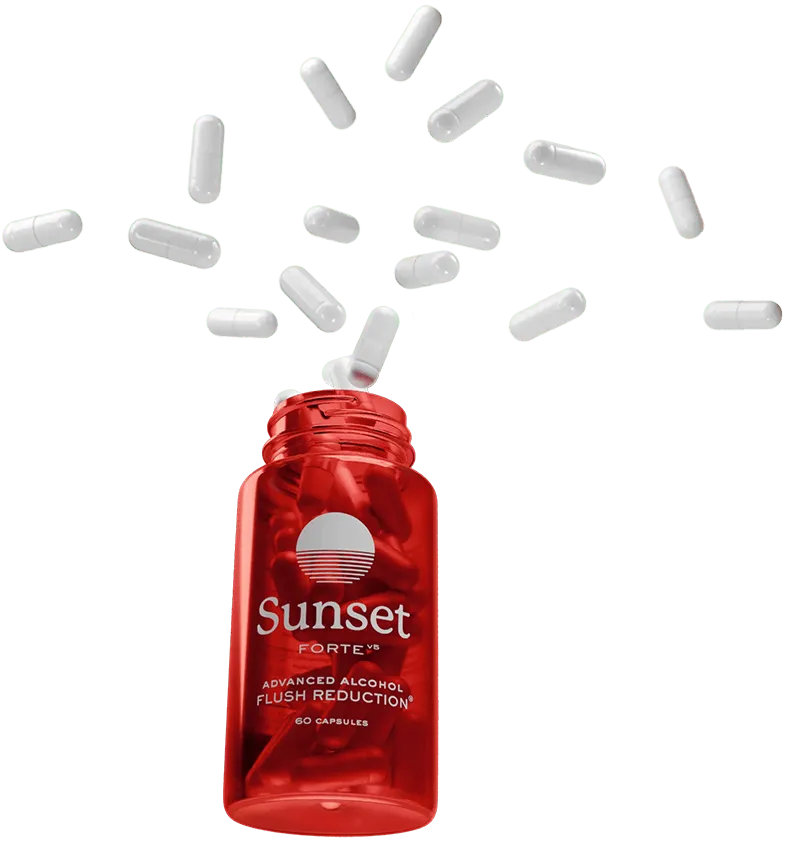
Sunset Forte uses a carefully formulated blend of Glutathione, Dihydromyricetin, Cysteine, L-Theanine, & B Vitamins to support natural acetaldehyde processing and a clearer, less-flushed look.
Learn more
94% of people who try Sunset are satisfied.