Alcohol Flush Reaction Cancer Risk: Is Asian Flush Dangerous Long Term?

⏱️ TL:DR ∙ Article in 20s
The alcohol flush reaction (ALDH2 deficiency) is linked to a substantially higher risk of oesophageal cancer, because affected people build up more of the carcinogen acetaldehyde when they drink — a link confirmed by the NIH and the IARC. The only proven way to lower that risk is to drink less, or not at all. For those who still drink occasionally, supplements built on NAC and S-Acetyl Glutathione (like Sunset) are formulated to support acetaldehyde clearance and ease the flush — but they are not cancer protection and don't replace cutting down. If the risk worries you, talk to a doctor.
- Alcohol Flush reaction: science and risks
- Acetaldehyde buildup and cancer risk
- Science behind cancer risk
- Managing your risks for cancer
Share this article
Copy and paste this link
That glow after a few drinks can seem harmless, but there's a well-documented connection between the alcohol flush reaction and an increased risk of certain cancers. If you get a red face after drinking alcohol, it's worth understanding exactly what's going on and how it can affect your health over the long term.
So are the claims of an Asian flush cancer risk actually real — or just another dubious "X causes cancer" headline?
In this case, the evidence is real and it comes from serious sources. People with genetic ALDH2 deficiency (the cause of Asian flush) have a higher risk of certain cancers, particularly of the oesophagus. Below we'll walk through exactly what the research says — and, just as importantly, what you can realistically do about it.
A Deep Look at the Science Behind the Alcohol Flush Cancer Risk
So what does the science actually say?
Back in 1996, a Japanese study examined the link between the flush reaction and oesophageal cancer — a cancer commonly seen in heavy drinkers. Comparing people who flush against those who don't, in both heavy-drinking and non-alcoholic groups, the researchers found a substantially higher oesophageal cancer risk among those with the flush.
Their conclusion, in plain terms: because people carrying the inactive ALDH2*2 variant build up high levels of acetaldehyde after drinking, and because acetaldehyde is a recognised carcinogen, that build-up appears to play a central role in alcohol-related oesophageal cancer. To understand why, it helps to look more closely at acetaldehyde itself.
The Cancer Risk Is Tied to Acetaldehyde Build-Up
As we explain in our Ultimate Guide to Asian Flush, the flush happens when your body can't break down acetaldehyde — a toxic by-product of alcohol metabolism — quickly enough, so it accumulates. That build-up is what causes the red face, and the same build-up is what the cancer concern centres on.
In other words, the red face isn't really the problem in itself — it's the visible sign of something more serious happening underneath.
In 2009, researchers from the US National Institute on Alcohol Abuse and Alcoholism (NIAAA) and Japan's Kurihama Alcohol Center published a major review of the evidence. The headline figures: people with one copy of the inactive ALDH2 variant are roughly 6–10 times more likely to develop oesophageal cancer than people with the fully active enzyme who drink comparable amounts. And those with the variant who drink heavily — 33 or more standard drinks a week — carry up to an 89-fold higher risk compared with non-drinkers.
The flush is a warning sign. The only proven way to lower this risk is to drink less — or not at all.
These aren't fringe figures — they come from a US government health body, and they describe a significantly heightened risk for people who have the flush and continue to drink. (If you'd like to reduce dietary acetaldehyde exposure too, see our guide to an ALDH2-deficiency diet.)
Confirmed by the International Agency for Research on Cancer (IARC)
That same year, the International Agency for Research on Cancer (IARC) — the cancer arm of the World Health Organization — classified acetaldehyde associated with alcohol consumption as a Group 1 carcinogen (its highest category, meaning carcinogenic to humans), alongside alcohol itself. The IARC also noted that people with the inactive enzyme metabolise acetaldehyde very slowly, reach higher internal levels of it, and face much higher risks of oesophageal and head-and-neck cancers than people with the active enzyme.
So both a leading US health body and the world's foremost cancer-research agency point the same way. This video runs through the key points:
Crucially, the 2009 NIAAA review didn't stop at documenting the risk. Because the flush is such a reliable marker of ALDH2 deficiency, the authors noted, a clinician can often spot an at-risk patient just by asking whether they go red when they drink — and they argued those patients should be counselled to cut down or stop drinking, with cancer screening considered for the highest-risk cases. It's the same throughline every authoritative source here keeps returning to: awareness, and drinking less, are the levers that actually reduce harm.
Which raises an obvious question: if you have the flush and face a higher risk, why drink at all? A 2005 study on alcohol, ALDH2 and oesophageal cancer addressed exactly that. It found strong evidence that alcohol raises oesophageal cancer risk — and that people whose flush reaction naturally leads them to drink less are, in effect, partly protected by it.
That's worth sitting with: the unpleasant symptoms of the flush are, in a sense, your body's built-in warning signal that acetaldehyde exposure is getting high. Suppressing that signal without reducing the drinking removes the warning, not the risk.
What Should You Actually Do About the Cancer Risk?
The honest, evidence-based answer is the one every source above points to: the most effective way to lower the risk is to drink less alcohol, or none at all. If you have the flush, cutting down is the single most powerful thing you can do — full stop.
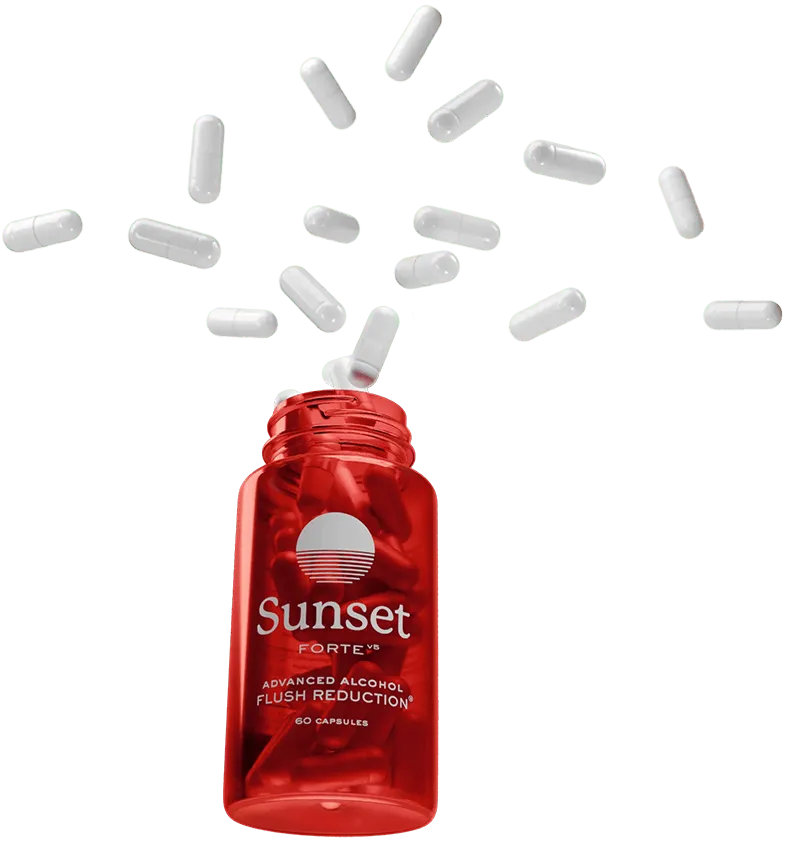
For those who still choose to drink occasionally, the research identifies acetaldehyde build-up as the carcinogenic culprit. Some compounds — notably NAC (N-acetylcysteine), which the body uses to produce the antioxidant glutathione — have been studied for their ability to help the body process acetaldehyde. That's the mechanism Sunset Alcohol Flush Support is built around: supporting your body's acetaldehyde clearance to make the flush more manageable.
We want to be straight about what that does and doesn't mean. Sunset can help with the flush reaction and the acetaldehyde load behind it, but it is not a cancer treatment and not a proven way to remove the cancer risk. No supplement should be treated as a substitute for the one thing that genuinely lowers that risk: drinking less. If you're concerned about your personal risk, the most important conversation is with a doctor — not a checkout page.
Final Thoughts on the Alcohol Flush Cancer Risk
So, is Asian flush dangerous in the long term? The evidence says yes: for people with ALDH2 deficiency who drink, there's a real and well-documented increase in oesophageal and head-and-neck cancer risk, driven by acetaldehyde. It's not scaremongering — it's the consensus of the NIH and the IARC.
The good news is that the risk is something you have real control over, because it's tied directly to how much you drink. Reducing your alcohol intake is the proven lever. If you do continue to drink, doing so in moderation — and supporting your body's acetaldehyde clearance — can help you manage the flush, but the less you drink, the lower the risk.
If you have questions, feel free to contact us. Or read more about sudden alcohol intolerance, the two-day hangover, how to get rid of the spins, or what causes a stuffy nose after drinking.
This article is for general education and isn't a substitute for advice from a qualified healthcare professional. If you're concerned about your cancer risk or your drinking, please speak with a doctor.
Enjoy your social life again — get Sunset Alcohol Flush Support for
33% off while stocks last!
What's inside?
Sunset Forte uses a carefully formulated blend of Glutathione, Dihydromyricetin, Cysteine, L-Theanine, & B Vitamins to support natural acetaldehyde processing and a clearer, less-flushed look.
Learn more
94% of people who try Sunset are satisfied.