Why do I itch after drinking? The real causes of alcohol-related skin reactions

Share this article
Copy and paste this link
Last Tuesday, a 28-year-old woman walked into a dermatology clinic in San Francisco with angry red welts across her chest and forearms. The intake form asked the standard questions — onset, duration, associated triggers. Under "aggravating factors," she wrote two words: red wine. Her dermatologist had seen this before. Itching after drinking alcohol is one of the most common complaints that patients either dismiss as a quirk or misattribute to a food allergy. But the clinical picture tells a more specific story.
The dermatologist translated the medical shorthand on the chart into plain English. "Ethanol-induced pruritus" — why do I itch after drinking, in doctor-speak. "Cutaneous vasodilation with urticarial features" — the red, raised, maddeningly itchy patches that erupt on the skin within minutes of a drink. According to the Mayo Clinic, these skin reactions are among the most common symptoms of alcohol intolerance, yet most patients have never been told why they happen.
What this patient needed to hear — and what most people searching for answers need to understand — is that alcohol-related itching has three distinct clinical causes, each with a different mechanism and a different fix. Histamine release, acetaldehyde buildup, and true allergic reaction. The dermatologist walked her through all three.
Cause 1: Histamine, the most common culprit
If your itching tends to come with flushing, a warm feeling in your skin, or raised bumps, histamine is the most likely explanation.
Alcohol directly triggers your mast cells (immune cells embedded in your skin and gut lining) to release stored histamine. On top of that, many alcoholic drinks are themselves packed with histamine. Red wine, beer, champagne, and aged spirits all contain high levels of it. So you're getting hit twice: your body is releasing its own histamine and absorbing more from the drink itself.
Once histamine is circulating, it binds to H1 receptors in your skin, causing vasodilation (blood vessels widening), local swelling, redness, and that maddening itch sensation. This is the exact same mechanism behind mosquito bites and hay fever: your skin is mounting an inflammatory response.
Some people are especially vulnerable because they're low in diamine oxidase (DAO), the enzyme responsible for breaking down histamine in the gut. If your DAO levels are low due to genetics, gut issues, or hormonal changes, you'll have a harder time clearing the histamine from that glass of Merlot before it reaches your skin. A review of alcohol and histamine metabolism found that alcohol itself may contain histamine, reduces DAO enzyme levels, and stimulates the synthesis of endogenous histamine.
This is also why some people reach for Pepcid (famotidine) before drinking. Famotidine is an H2 blocker, meaning it reduces one branch of the histamine response. Over-the-counter antihistamines like cetirizine (Zyrtec) target H1 receptors. Both can help with histamine-driven itch, but neither addresses the other two causes on this list. And they don't touch acetaldehyde.
Cause 2: Acetaldehyde, the toxic metabolite behind flush and itch
If your itching shows up alongside facial flushing, a racing heartbeat, or a stuffy nose, the cause likely runs deeper than histamine alone.
Every time you drink, your liver converts ethanol into acetaldehyde, a toxic compound that's 10–30 times more toxic than alcohol itself. Normally, an enzyme called ALDH2 (aldehyde dehydrogenase 2) breaks acetaldehyde down quickly into harmless acetate. But roughly 540 million people worldwide carry a genetic variant called ALDH2*2 that cripples this enzyme's activity, leaving acetaldehyde to accumulate in the body.
That buildup directly affects your skin. Research on alcohol and histamine has shown that alcohol and acetaldehyde liberate histamine from mast cells and depress histamine elimination by inhibiting diamine oxidase, compounding the inflammatory response and contributing to oxidative stress. The result is a skin reaction that looks and feels a lot like a histamine response but originates from a completely different source.
This is why antihistamines alone often don't fully resolve the itch for people with ALDH2 deficiency. You can block the histamine receptors all you want, but if acetaldehyde keeps accumulating and triggering new rounds of inflammation, the skin irritation keeps coming back. The root cause is acetaldehyde buildup, not histamine alone.
ALDH2 deficiency is most common among people of East Asian descent (30–40% prevalence), which is why the cluster of symptoms — facial flushing when you drink, itching, nausea, rapid heartbeat — is often called Asian flush or alcohol flush reaction. But the variant exists in other populations too, and itching can be a primary symptom even when flushing is mild.
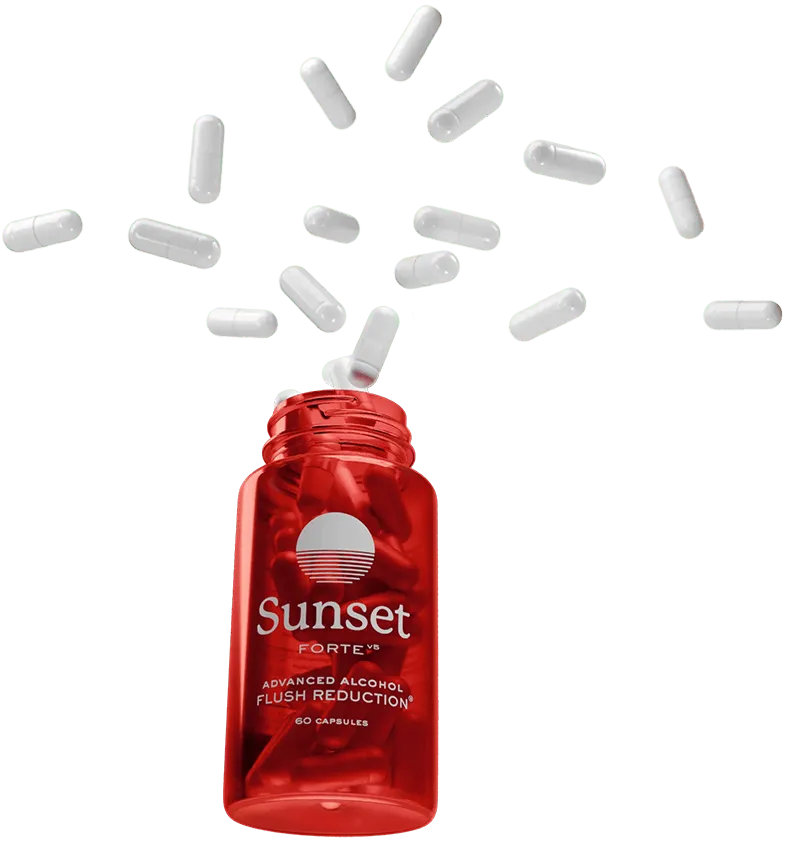
If your itching is accompanied by facial flushing, a stuffy nose, or a racing heart, ALDH2 deficiency is likely at the root. Sunset is formulated to support your body's acetaldehyde clearance. Find out how →
Cause 3: True alcohol allergy and urticaria
A genuine allergy to ethanol itself is rare, but it does exist. And allergic reactions to specific ingredients in alcoholic drinks are more common than most people realize.
In a true IgE-mediated allergy, your immune system identifies a substance as a threat and mounts an aggressive response. With alcohol, the trigger is usually not the ethanol but something else in the drink: wheat or gluten in beer, grapes or sulphites in wine, corn-derived ingredients in bourbon, or yeast proteins in unfiltered ales. The resulting reaction can range from mild urticaria (hives) to angioedema (deeper tissue swelling) to, in severe cases, anaphylaxis.
How do you tell the difference between alcohol allergy vs intolerance? Timing and severity are the biggest clues. Allergic reactions tend to be rapid (within minutes), can escalate quickly, and may include throat tightening, difficulty breathing, or widespread hives beyond just the face and neck. Intolerance reactions are uncomfortable but generally don't involve anaphylaxis risk.
If you suspect a true allergy, especially if you've ever had throat swelling or breathing difficulty after drinking, see an allergist. Skin prick testing can identify specific ingredient triggers and help you avoid them. This isn't something to guess about.
Other drinks that cause more itching (and why)
Not all drinks are equally likely to make you itch. Here's a quick breakdown of the worst offenders.
Risk scale 1–5: higher = more likely to trigger itching. Acetaldehyde is produced by all drinks regardless of rank.
Red wine sits at the top. It's high in histamine, contains sulphites in wine and beer, and includes tannins that act as histamine liberators, meaning they cause your body to release even more histamine on top of what's already in the glass.
Beer is a double threat for people sensitive to gluten, wheat, or yeast, and it carries moderate histamine levels. Unfiltered craft beers and wheat ales tend to be worse than light lagers.
Champagne and sparkling wine combine histamine with sulphites and carbonation, which can speed up alcohol absorption and accelerate the whole reaction.
Dark spirits (whiskey, bourbon, brandy) contain congeners, fermentation byproducts that can intensify inflammatory responses.
Clear spirits like vodka and gin tend to cause the fewest histamine-related issues. If you're experimenting to identify your triggers, they're the safest starting point, though they'll still produce acetaldehyde, so they won't help if ALDH2 deficiency is your underlying issue.
Is itching after drinking a sign of liver damage?
This question comes up a lot, and it deserves a straight answer.
In most cases, itching after drinking is caused by one of the three mechanisms above — histamine, acetaldehyde, or allergy — and has nothing to do with your liver's structural health. It's an acute reaction to a specific drinking session, not a sign of organ damage.
That said, there is a condition called cholestatic pruritus where chronic itching results from bile salt accumulation due to impaired liver function. This type of itch is persistent (not just after drinking), often worse at night, and typically concentrated on the palms of your hands and soles of your feet. It's associated with alcohol-related liver disease (ARLD) and other hepatic conditions, and it develops gradually over years of heavy drinking, not from a couple of glasses of wine on a Saturday.
If your itching only happens after drinking and resolves within a few hours, liver damage is unlikely to be the cause. But if you're experiencing persistent, unexplained itching that happens regardless of whether you've been drinking — especially alongside fatigue, yellowing skin, or dark urine — get a liver function test (LFT). It's a simple blood draw that measures ALT, AST, and other markers. Your GP can order one.
What you can do about it
The right fix depends on what's driving your itch.
For histamine-driven reactions: An over-the-counter H1 antihistamine (cetirizine or loratadine) taken before drinking can reduce symptoms. Switching to lower-histamine drinks, like clear spirits over red wine, also helps. If you want to understand the antihistamine approach in more detail, we've written about antihistamines for alcohol flush and when they work (and when they don't).
For acetaldehyde-related itch: Antihistamines will only partially help, because the root problem is upstream. Supporting your body's ability to clear acetaldehyde is the more effective strategy. Staying hydrated, eating before you drink, and pacing yourself all reduce the acetaldehyde load your body has to handle at any given moment.
For suspected allergies: Identify the specific ingredient trigger through elimination testing or an allergist visit, then avoid it. There's no supplement that fixes a true IgE-mediated allergy.
For everyone: Keep a simple log of what you drank and what symptoms followed. Two weeks of data will tell you more than any amount of Googling.
For people whose itch is tied to flushing and other Asian flush symptoms, Sunset Alcohol Flush Support addresses the underlying acetaldehyde buildup. Shop Sunset →
Want to understand the bigger picture? The Ultimate Guide to Asian Flush →
Enjoy your social life again — get Sunset Alcohol Flush Support for
33% off while stocks last!
What's inside?
Sunset Forte uses a carefully formulated blend of Glutathione, Dihydromyricetin, Cysteine, L-Theanine, & B Vitamins to support natural acetaldehyde processing and a clearer, less-flushed look.
Learn more
94% of people who try Sunset are satisfied.