How to Get Rid of the Spins When Drunk: Stop the Dizziness

⏱️ TL:DR ∙ Article in 20s
The spins isn't a stomach problem — it's vertigo from your inner ear: alcohol makes your balance sensor float and fire false "you're moving" signals, worst when you lie down with your eyes shut. To settle it now, open your eyes and fix on a still point, sit up and plant one foot on the floor, and sip water — it fades as you sober up (usually 3–7 hours). And because the spins makes people vomit, roll anyone who can't stay awake onto their side and get help.
Action items:
- The spins isn't in your stomach — it's in your ears
- Why alcohol makes the room spin
- Why the spins comes back the next morning
- How to stop the spins right now
- When the spins is actually an emergency
- How to dodge the spins next time
Share this article
Copy and paste this link
You've made it to bed, you close your eyes — and the room lurches into motion. The ceiling tilts, the bed feels like a raft, and your stomach turns with it. The spins have arrived.
Here's what's actually happening in your head, how to settle it in the moment, and the one version of the spins that's genuinely dangerous.
The spins isn't in your stomach — it's in your ears
It feels like a gut problem because of the nausea, but the spins starts in your inner ear, in the balance organ called the vestibular system.
Deep in each ear sit three fluid-filled loops, the semicircular canals. Inside them, a tiny sensor called the cupula moves as you move and tells your brain which way is up. Mass Eye and Ear vestibular specialist Dr. Matthew Crowson compares it to a weathervane: it reads your motion the way a vane reads the wind. Alcohol makes that weathervane misfire.
Why alcohol makes the room spin
Normally the cupula and the endolymph fluid around it are the same density, so gravity has no effect when you hold still. Alcohol breaks that balance.
Because alcohol is lighter than water and seeps into the cupula faster than into the surrounding fluid, the cupula briefly becomes lighter than the endolymph. Now it floats — drifting with gravity even when your head is perfectly still, and firing off false "you're moving" signals. This is the buoyancy hypothesis behind positional alcohol nystagmus, the medical name for the spins.
As Dr. Crowson puts it: "More alcohol makes the balance sensors in your head sensitive." Small motions — turning your head on the pillow, shifting your weight — become enough to set the whole system off.
It's worse the moment you lie down and shut your eyes for a reason. Your eyes are normally feeding your brain a steady visual reference that overrides the bad signal. Close them, and there's nothing left to argue with the inner ear — so the spinning takes over.
Why the spins comes back the next morning
There's a cruel second act. As your liver clears the alcohol, the whole process runs in reverse: alcohol leaves the cupula faster than the fluid, so now the cupula becomes heavier than the endolymph — and you spin the other way.
That's why you can wake still feeling the room drift, hours after your last drink. It's the same mechanism flipped, and it's a real contributor to that miserable next-day haze. Per Dr. Crowson, the whole thing lasts only as long as it takes your body to clear the alcohol — roughly three to seven hours.
How to stop the spins right now
You can't speed alcohol out of your system, but you can give your brain a truthful signal to drown out the false one. Dr. Crowson's advice is to use your other senses to override the inner ear — the same trick taught to vertigo patients.
- Open your eyes and lock onto something still. A fixed point on the wall or ceiling gives your brain a visual anchor that contradicts the spinning.
- Sit up and plant a foot on the floor. Firm contact with solid ground — sitting upright, one foot flat — feeds your brain steady "I'm not moving" signals through touch.
- Slow your breathing. Deep, slow breaths settle the panic and the racing heart rate that the spinning kicks off.
- Sip water and wait it out. Hydration won't cure it, but it helps — and the spins fades on its own as your body clears the alcohol.
When the spins is actually an emergency
Most of the time the spins is just miserable. But it makes people vomit — and vomiting while lying down, especially if someone has passed out, carries a real risk of choking on it (pulmonary aspiration). That's the genuinely dangerous part.
If someone is passed out and can't be woken, is vomiting while unconscious, or has slow or irregular breathing, treat it as a possible alcohol overdose: roll them onto their side into the recovery position, never leave them on their back, stay with them, and call emergency services.
One more flag from Dr. Crowson: if the room is still spinning well after the alcohol should be gone, get it checked. Persistent vertigo can occasionally signal something else entirely — a vestibular disorder, or rarely a stroke — that shouldn't be written off as just a heavy night.
How to dodge the spins next time
The spins tracks with how high and how fast your blood alcohol climbs, so the prevention is all about keeping that curve gentle:
- Pace yourself. The spins tends to hit around the point of heavier, faster drinking — spacing drinks out keeps your peak lower.
- Eat first and drink water alongside. Food slows absorption; water slows you down and offsets the dehydration that makes dizziness worse.
- Know your limit. The drink that tips you into the spins is personal — once you've found it, that's your line.
The bottom line
The spins is vertigo, not a stomach bug: alcohol lightens the balance sensor in your inner ear, so it floats and tells your brain you're moving when you're not. It fades as you sober up.
In the moment, open your eyes, fix on something still, sit up and ground a foot on the floor. To avoid it, drink slower and lower — and if a friend is spinning and vomiting while they can't stay awake, put them on their side and get help.
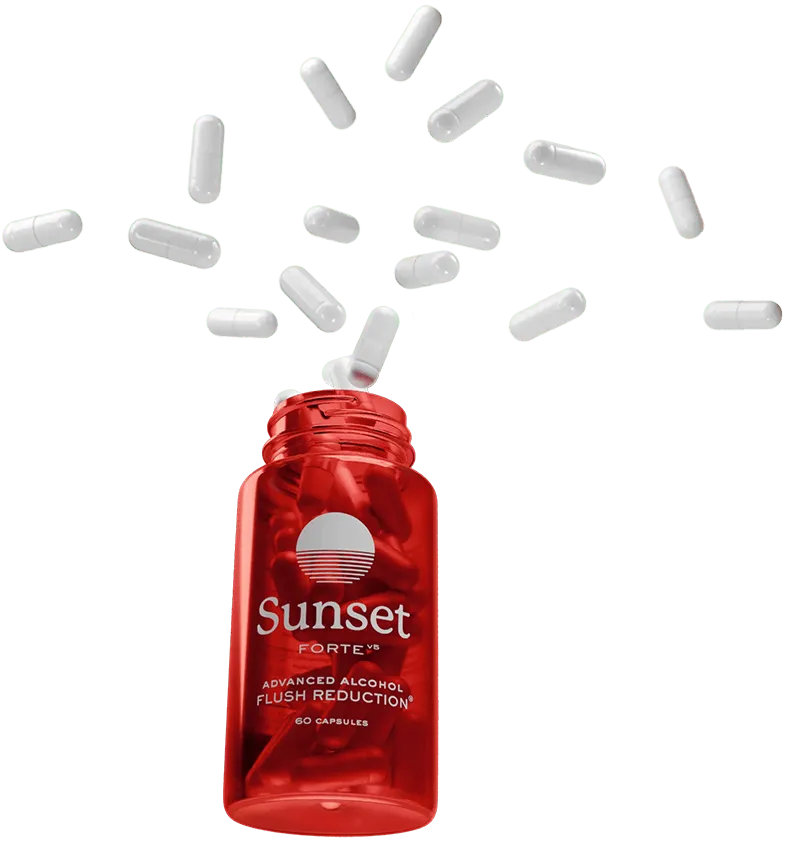
Enjoy your social life again — get Sunset Alcohol Flush Support for
33% off while stocks last!
What's inside?
Sunset Forte uses a carefully formulated blend of Glutathione, Dihydromyricetin, Cysteine, L-Theanine, & B Vitamins to support natural acetaldehyde processing and a clearer, less-flushed look.
Learn more
94% of people who try Sunset are satisfied.