Why Does Alcohol Make Me Sleepy? The Science of the 3am Wake-Up

⏱️ TL:DR ∙ Article in 20s
TL;DR: Alcohol is a sedative — it slows your brain, so you fall asleep faster. But the effect is biphasic: as your liver clears it, your nervous system rebounds, cortisol and heart rate climb, and the night's second half fragments — the classic wired-at-3am wake-up. It also suppresses restorative REM sleep, so even a "full" night leaves you groggy. The takeaway: don't lean on alcohol as a sleep aid — faster sleep onset isn't worth the wrecked second half.
- Why alcohol makes you drowsy
- Why it wakes you up a few hours later
- The sleep you do get isn't the sleep you need
- The other ways alcohol drags down your night
- If you also get the flush reaction
- How to drink without wrecking your sleep
Share this article
Copy and paste this link
You're a couple of drinks in, the conversation is still going, and your eyelids start to sink. Everyone else seems fine — but you could curl up and sleep right there at the table.
It's one of alcohol's most reliable effects, and there's nothing wrong with you. Alcohol is a sedative, and it pulls several of your brain's sleep levers at once. The catch is that the sleep it gives you isn't the sleep you actually need — and a few hours later it does the opposite, snapping you awake.
Here's exactly why both halves of that happen, and how to drink without wrecking your night.
Why alcohol makes you drowsy
Your brain runs on a balance between signals that rev you up and signals that calm you down. Alcohol tips that balance hard toward calm.
It boosts GABA, the brain's main "brake" — the same calming chemical that sedatives and anaesthetics work on. At the same time it dampens glutamate, your brain's main "accelerator." Less accelerator, more brake: neurons fire slower, and you feel heavy-lidded and relaxed.
There's a third lever too. Alcohol raises adenosine — the molecule that builds up all day to create "sleep pressure" and makes you feel more tired the longer you're awake. A drink spikes it artificially, which is why a nightcap can feel like a shortcut to lights-out.
But sedation isn't sleep. As UC Berkeley neuroscientist Matthew Walker told NPR, with alcohol "what you're doing there is simply knocking yourself out" — removing consciousness, not easing into natural sleep.
Why it wakes you up a few hours later
Alcohol has what researchers call a biphasic effect: it calms you first, then stimulates you. The first half of the night you're sedated. Then, as your liver clears the alcohol, the whole thing reverses.
The brake (GABA) lets go and the accelerator (glutamate) comes roaring back — a rebound that swings your nervous system from sedated to over-aroused. Add a rise in the stress hormone cortisol and a climbing heart rate, and you get the classic 3am jolt: wide awake, often anxious, unable to drop back off.
This is the part people miss. A review of 20 studies covering more than 500 people found alcohol reliably helped people fall asleep faster and deepened sleep early on — then disrupted it in the second half. As the review's author, sleep physician Dr. Irshaad Ebrahim, put it: "Sleep may be deeper to start with, but then becomes disrupted."
The sleep you do get isn't the sleep you need
Even when alcohol keeps you unconscious through the night, it quietly degrades the quality of your sleep — mainly by stealing your REM sleep.
REM is the dreaming stage that handles memory, learning and emotional processing, and it's concentrated in the back third of the night — exactly when alcohol's rebound is fragmenting things. Suppress it, and you wake up foggy, flat and unrested even after a "full" night.
And the awakenings are real, even if you don't remember them. As Cleveland Clinic sleep specialist Dr. Nancy Foldvary-Schaefer explains, "Alcohol in your system leads to your sleep being fragmented" — your brain briefly surfacing over and over, interrupting the cycle without fully waking you.
The other ways alcohol drags down your night
Beyond the biphasic swing, alcohol piles on a few more problems:
- Snoring and sleep apnea. Alcohol relaxes the muscles in your throat and airway, so they collapse more easily. Johns Hopkins specifically advises against alcohol and sedatives for anyone prone to obstructive sleep apnea.
- A racing heart and bathroom trips. The cortisol bump lifts your heart rate while you're trying to rest, and alcohol's diuretic effect sends you to the toilet — each a chance to wake fully.
- Suppressed melatonin. Evening drinking blunts the hormone that times your sleep-wake cycle, nudging your body clock out of sync.
Stack these together and the "I slept eight hours but feel terrible" morning makes complete sense — and it's a big reason a heavy night so often turns into a two-day hangover.
If you also get the flush reaction
For some people there's an extra layer. If you have alcohol intolerance or the Asian flush reaction, drinking also brings a pounding heart, facial flushing and a stuffy nose — driven by a build-up of acetaldehyde. Lying there hot, congested and racing makes it even harder to settle.
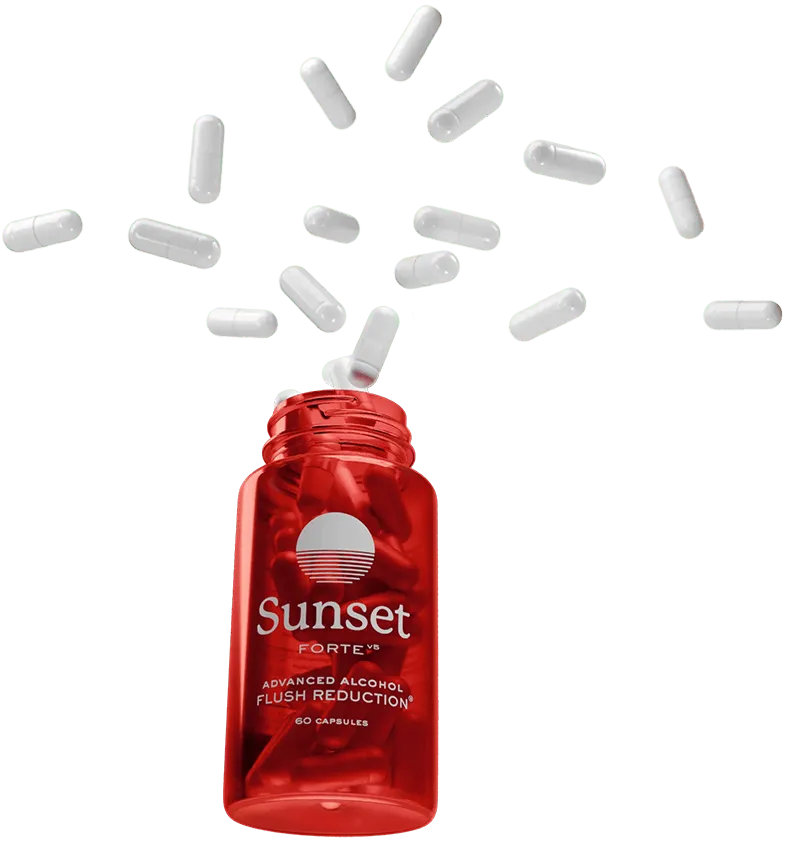
To be clear, nothing fixes alcohol's effect on your sleep architecture except drinking less — no supplement restores the REM you lose. What supporting acetaldehyde clearance can do is ease the flush discomfort itself, which is the angle Sunset Alcohol Flush Support is built around. It's not a sleep aid, and it won't undo the fragmentation alcohol causes.
How to drink without wrecking your sleep
You can't switch off the biphasic effect, but timing and amount make a real difference:
- Stop drinking earlier. Give your body a few hours to clear the alcohol before bed, so the rebound lands before sleep rather than during it.
- Keep it moderate. The second-half disruption scales with the dose — fewer drinks, smaller swing.
- Hydrate and eat. Alternating with water and drinking on a full stomach softens both the dehydration and the blood-sugar dip that add to next-day fatigue.
- Don't use it as a sleep aid. A nightcap buys faster sleep onset at the cost of the night's second half — a bad trade, and a habit that tends to deepen.
If you regularly rely on a drink to fall asleep, or you wake at 3am wired and anxious, that's worth taking seriously — and worth raising with a doctor.
The bottom line
Alcohol makes you sleepy because it's a sedative — it pulls the brakes on with GABA and adenosine and eases off the accelerator. That's why you fade fast.
But sedation isn't rest. A few hours later the effect flips, your brain rebounds, and the back half of your night fragments while your REM sleep takes the hit. You can blunt it by drinking less and earlier — but the truest fix for sleep is to keep alcohol out of the equation before bed.
Enjoy your social life again — get Sunset Alcohol Flush Support for
33% off while stocks last!
What's inside?
Sunset Forte uses a carefully formulated blend of Glutathione, Dihydromyricetin, Cysteine, L-Theanine, & B Vitamins to support natural acetaldehyde processing and a clearer, less-flushed look.
Learn more
94% of people who try Sunset are satisfied.