NAC for Asian Flush: What N-Acetyl Cysteine Actually Does (And Doesn't Do)

Share this article
Copy and paste this link
NAC for Asian flush is one of the most confidently repeated recommendations in online health communities. Reddit threads, supplement forums, and pre-drinking protocol lists all treat N-acetyl cysteine as a near-proven fix for alcohol flush reaction. The confidence is misplaced.
A 2024 randomized controlled trial put NAC to the test and found it did not reduce hangover symptoms compared to placebo. That single finding should reframe every "NAC cured my Asian flush" anecdote circulating online.
But dismissing NAC entirely would also be wrong. The study tested general hangover sufferers, not people with the ALDH2 enzyme deficiency that drives the flush reaction. Those are fundamentally different biochemical problems, and NAC's mechanism — replenishing the glutathione your liver burns through when acetaldehyde accumulates — matters far more when that enzyme is broken.
The real story is more nuanced than either camp admits. Here's what NAC actually does in the body, where the evidence stands, and why it works best as one piece of a larger formula rather than a standalone fix.
What is NAC (N-acetyl cysteine)?
N-acetyl cysteine is a supplemental form of the amino acid cysteine. It's been used in clinical medicine for decades as a mucolytic drug for respiratory conditions and as the frontline antidote for acetaminophen overdose.
What makes NAC relevant to alcohol metabolism is its role as the rate-limiting precursor to glutathione, often called the body's "master antioxidant." Your liver depends on glutathione to neutralize reactive oxygen species and manage oxidative stress, both of which spike when you drink.
NAC is available over the counter in the US and has gained a massive following in online health communities. But for our purposes, the glutathione connection is what matters most.
How NAC interacts with alcohol and acetaldehyde
To understand where NAC fits, you need to understand how your body processes acetaldehyde.
When you drink, your liver converts ethanol into acetaldehyde, a toxic compound classified as a Group 1 carcinogen. Normally, ALDH2 (aldehyde dehydrogenase 2) converts that acetaldehyde into harmless acetic acid.
But if you carry the ALDH2 genetic variant common in people of East Asian descent, that enzyme is partially or severely dysfunctional. Acetaldehyde builds up. Your face goes red. Your heart races. You feel awful.
Here's the distinction worth making: NAC does not directly break down acetaldehyde. It doesn't speed up ALDH2 or substitute for the missing enzyme activity. What it does is replenish glutathione, and glutathione helps your body manage the oxidative damage that acetaldehyde causes as it accumulates.
If acetaldehyde is a fire, ALDH2 is the firefighter that puts it out. NAC isn't another firefighter. It's the protective gear that keeps the surrounding damage from spreading while the fire burns.
When acetaldehyde builds up, it triggers a cascade of reactive oxygen species that damage cells and tissues. Glutathione is the body's primary defense against this oxidative assault, and alcohol depletes it rapidly, which is exactly why having a precursor like NAC on board matters.
Does NAC get rid of acetaldehyde? Not directly. But it supports the glutathione system that helps your body manage the acetaldehyde it can't clear quickly enough.
What the research says: the honest picture
If we're going to be straight about NAC, we need to talk about the study that dampened a lot of enthusiasm.
A 2024 randomised controlled trial published in MDPI's Toxics journal tested NAC for alleviating hangover symptoms. The results were disappointing: NAC did not significantly reduce hangover severity compared to placebo.
That's a real finding and shouldn't be swept aside. If someone tells you "just take NAC before drinking and you'll feel fine," the clinical evidence doesn't support that for the general population.
But here's the nuance that matters: a hangover and the Asian flush reaction are not the same thing.
Hangovers involve a broad mix of mechanisms: dehydration, inflammation, sleep disruption, GI irritation. The flush reaction is more specific. It's driven primarily by acetaldehyde accumulation due to impaired ALDH2 function. People with ALDH2 deficiency experience dramatically higher oxidative stress from alcohol, exactly the kind of stress that glutathione (and by extension, NAC) is designed to buffer against.
The honest framing: NAC alone isn't a hangover cure. The research is clear on that. But its role in glutathione support may still benefit people with Asian flush specifically, particularly when combined with other ingredients that address the acetaldehyde pathway more directly.
If you get headaches after drinking even small amounts, that's another signal your acetaldehyde clearance needs more support than any single ingredient provides.
Where NAC does help: the Asian flush use case
After those caveats, here's where NAC earns its place.
People with ALDH2 deficiency, the genetic root of Asian flush, face a unique biochemical challenge. Their ALDH2 enzyme can't clear acetaldehyde efficiently, so they experience higher oxidative stress from alcohol than someone with normal enzyme function. Their glutathione stores deplete faster and more completely.
That's the specific scenario where NAC's mechanism is most relevant. By providing the raw material for glutathione synthesis before the oxidative load hits, NAC creates an antioxidant buffer. It won't fix the ALDH2 bottleneck itself, but it reduces the collateral damage while other ingredients (like DHM) work on the upstream problem.
The Asian flush population needs glutathione support the most and depletes it the fastest. NAC is well suited for that gap, not as a standalone solution, but as a strong supporting player.
NAC works best as part of a complete formula. See how Sunset combines NAC with DHM and other cofactors for fuller Asian flush support. See Sunset's Formula →
NAC dosage and timing for Asian flush
Most studies and supplement protocols use NAC in the range of 600 mg to 1,200 mg per dose. For alcohol-related use, timing matters: NAC should be taken 30 to 60 minutes before drinking to allow absorption and give your body time to start converting it into glutathione.
NAC's oral bioavailability is low (around 6–9%), which is why the dosage is higher than you might expect. Taking it on an empty stomach improves absorption, though some people experience mild nausea. A light snack is a reasonable trade-off.
Why do I feel good after taking NAC? Many people report clarity or reduced brain fog. This likely relates to glutathione's role in reducing systemic oxidative stress. For drinking, the benefit is more targeted: you're giving your body a head start on antioxidant defense before alcohol depletes it.
Even at higher doses, NAC alone isn't addressing the core ALDH2 enzyme problem. That's why combining it with ingredients that support acetaldehyde breakdown directly makes a stronger protocol.
NAC + DHM: why the combination makes sense
If NAC supports the body's antioxidant defenses, DHM (dihydromyricetin) works on the other side of the equation. DHM is a flavonoid from the Japanese raisin tree (Hovenia dulcis) studied for its ability to support ALDH2 enzyme activity and acetaldehyde conversion.
NAC and DHM address the alcohol flush reaction at two different points in the pathway.
- DHM targets the upstream problem: supporting the enzyme activity that converts acetaldehyde into harmless acetic acid
- NAC handles downstream damage: replenishing glutathione to mop up the oxidative stress acetaldehyde generates
Neither ingredient alone covers the full picture. DHM without antioxidant support leaves your body exposed to oxidative damage. NAC without enzyme support leaves the acetaldehyde bottleneck unaddressed. Together, they cover both sides.
Sunset includes NAC alongside DHM and additional ingredients specifically formulated for people with Asian flush. Try Sunset →
How Sunset uses NAC in its formula
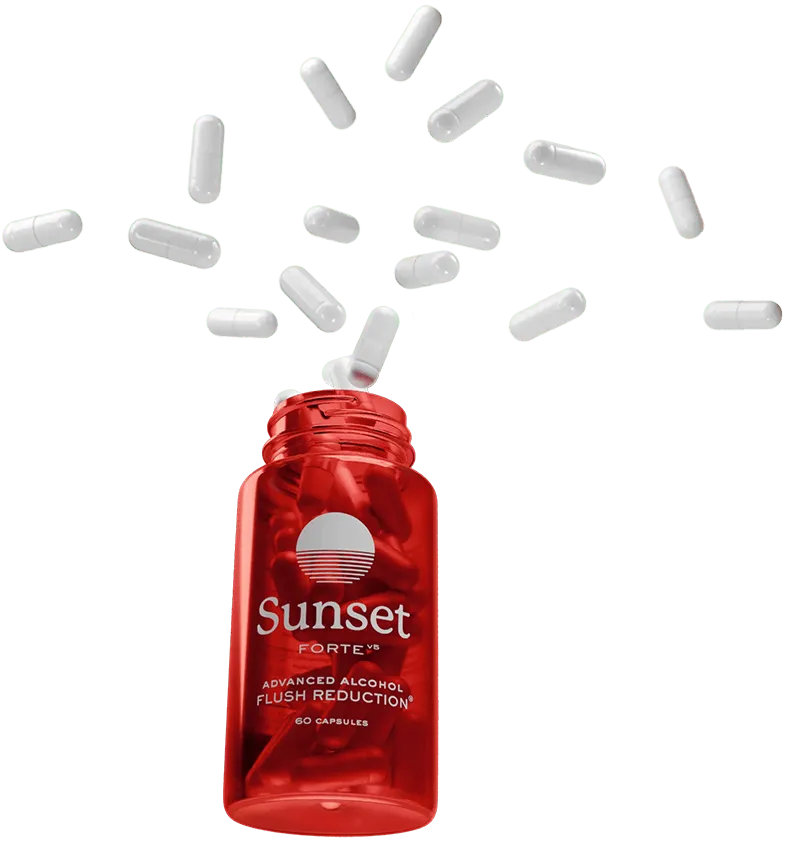
Sunset Alcohol Flush Support was built on the principle that no single ingredient solves Asian flush. NAC is included as the antioxidant component within a broader formula that also features:
- DHM for ALDH2 enzyme support
- Picrorhiza kurroa for liver protection under oxidative stress
- B vitamins (B1, B6, B12) as cofactors that alcohol depletes
NAC isn't the star of the formula, DHM takes that role. But it plays a real supporting part: keeping your glutathione system stocked and ready when your body needs it most.
Take Sunset 30 minutes before your first drink. The formulation handles timing and dosage balance so you don't need to piece together a stack from five different bottles.
Frequently asked questions
Is NAC safe to take before drinking?
For most healthy adults, NAC is well tolerated at standard doses (600–1,200 mg). It has a long safety track record in clinical settings. If you're on medications, particularly nitroglycerin or blood thinners, check with your doctor first, as NAC can interact with certain drugs.
Can I take NAC and Pepcid together for Asian flush?
There's no known direct interaction between NAC and famotidine (Pepcid). But they do very different things. NAC supports glutathione production, while Pepcid blocks histamine receptors to reduce visible redness. Pepcid doesn't address acetaldehyde accumulation. Read about why Pepcid doesn't address acetaldehyde and the risks of masking the flush.
How is NAC different from taking Pepcid?
Fundamentally different mechanisms. NAC is a glutathione precursor that supports your body's antioxidant defense. Pepcid is an antihistamine that blocks the redness signal without touching the underlying acetaldehyde problem. NAC works with your metabolism; Pepcid works around one symptom.
Does NAC cure Asian flush?
No. No supplement can change your ALDH2 genetics. What NAC can do is support the glutathione system that helps manage oxidative stress from acetaldehyde accumulation. It's a meaningful tool, but a supporting player, not a cure.
How long does NAC take to work for alcohol?
Take it 30 to 60 minutes before drinking to allow absorption and glutathione synthesis to begin. The effects aren't dramatic like a painkiller. NAC works at the cellular level to bolster antioxidant reserves. Most people find it more effective as part of a multi-ingredient approach than on its own.
Still researching? Read our complete guide to preventing Asian flush.
Enjoy your social life again — get Sunset Alcohol Flush Support for
33% off while stocks last!
What's inside?
Sunset Forte uses a carefully formulated blend of Glutathione, Dihydromyricetin, Cysteine, L-Theanine, & B Vitamins to support natural acetaldehyde processing and a clearer, less-flushed look.
Learn more
94% of people who try Sunset are satisfied.