How to Prevent Asian Flush: Every Method Compared (2026 Guide)

- What is Asian flush?
- Supplements (enzyme approach)
- Antihistamines (Pepcid etc.)
- Asian flush patches
- Choosing the right drink
- Lifestyle and habits
- Already red? Quick fixes
- Every method compared
- FAQ
- The bottom line
Share this article
Copy and paste this link
This guide compares every method for preventing Asian flush — from purpose-built supplements and antihistamines to drinking strategies, drink selection, and genetic workarounds — and ranks them by evidence quality. No vague listicles, no sponsored fluff, no lectures about quitting.
The goal is simple: a clear, honest answer to how to prevent Asian flush, based on what the science actually says about each approach. Every method gets the same treatment — mechanism, effectiveness score, safety profile, and whether it addresses the root cause (acetaldehyde buildup) or just masks the redness.
Here is exactly what the article covers, in order: the biology behind alcohol flush reaction, five distinct prevention methods scored head-to-head in a comparison table, immediate remedies for mid-flush situations, and an FAQ section addressing the most common follow-up questions. Each method section explains how the approach works, what it actually does to acetaldehyde levels, and where it falls short.
The result is a single reference page that replaces a dozen half-answers scattered across Reddit threads and outdated blog posts.
Note: This article is educational and not a substitute for medical advice. If you experience severe reactions to alcohol, please consult a healthcare professional.
What is Asian flush and why does it happen?
Asian flush, also called alcohol flush reaction or Asian glow, is what happens when your body can't efficiently clear acetaldehyde, the toxic byproduct your liver produces when it breaks down alcohol.
Here's the short version: your body metabolizes alcohol in two steps. First, an enzyme called alcohol dehydrogenase (ADH) converts ethanol into acetaldehyde. Then a second enzyme, aldehyde dehydrogenase 2 (ALDH2), is supposed to convert that acetaldehyde into harmless acetic acid.
Where Asian Flush Begins
Understanding where the breakdown happens is key to choosing a prevention method that actually addresses the root cause — not just the symptoms.
If you have ALDH2 deficiency, a genetic variant carried by an estimated 540 million people worldwide, predominantly those of East Asian descent, that second step doesn't work properly. Acetaldehyde builds up in your blood, triggering vasodilation (blood vessels widening), histamine release, a racing heartbeat, nausea, headaches, and that unmistakable red face.
So when your face flushes after a drink, it's not a cosmetic quirk. It's a metabolic signal: your body telling you that a Group 1 carcinogen is accumulating faster than it can be cleared. According to the Cleveland Clinic, this reaction is one of the most common signs of alcohol intolerance.
That context changes how you evaluate every "solution" on the market. The real question isn't "how do I hide the redness?" It's "how do I help my body deal with acetaldehyde?"
For a more thorough look at the condition itself, read our complete guide to Asian flush.
Method 1: Purpose-built supplements (the enzyme approach)
If the problem is a metabolic bottleneck, ALDH2 not clearing acetaldehyde fast enough, the most logical approach is to support that pathway directly.
This is where purpose-built supplements come in. Rather than masking symptoms, the enzyme approach works with your body's existing metabolism, providing the cofactors and compounds it needs to process acetaldehyde more effectively.
Sunset Alcohol Flush Support was designed specifically for this. Its formulation includes:
- DHM (dihydromyricetin), a flavonoid extracted from the Japanese raisin tree (Hovenia dulcis) that has been studied for its role in supporting alcohol metabolism. Research catalogued by the NIH's LiverTox database documents DHM's pharmacological properties in the context of alcohol exposure.
- NAC (N-acetyl cysteine), a precursor to glutathione, your body's primary antioxidant and a major player in acetaldehyde detoxification. NAC supports the production of the very molecule your body uses to neutralize acetaldehyde.
- Picrorhiza kurroa, a hepatoprotective herb traditionally used to support liver function.
- B vitamins (B1, B6, B12), cofactors in alcohol metabolism that get depleted when your body processes ethanol.
What makes this approach different is that it targets the cause of the flush, not just the visible symptom. You're not turning off the warning light. You're addressing what the warning light is pointing at.
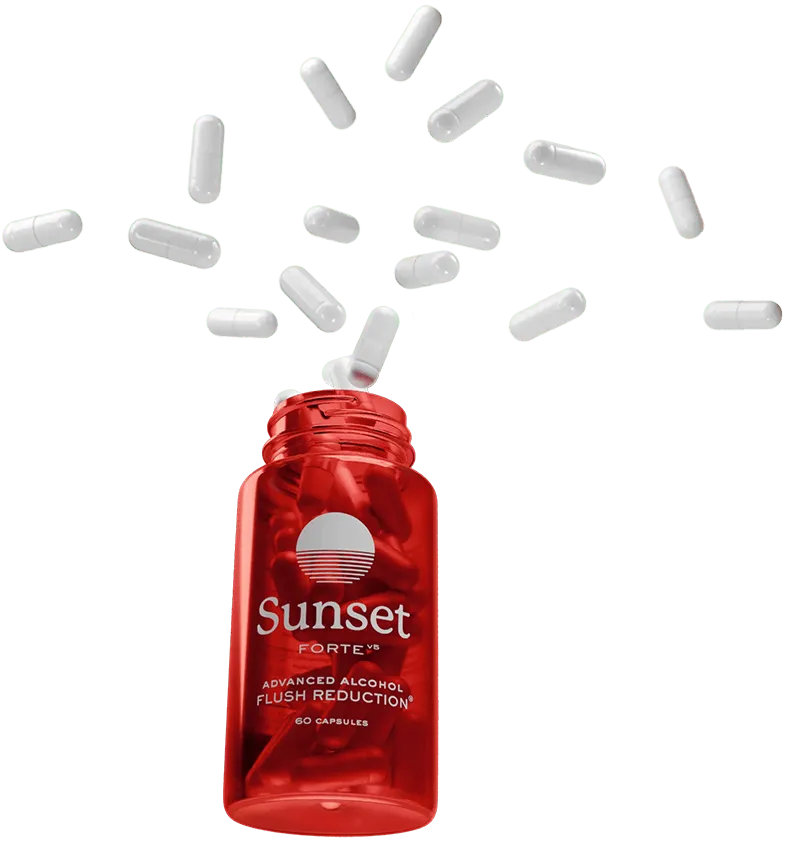
For people with more severe reactions, Sunset Forte offers a stronger formulation with higher concentrations of active ingredients.
Try Sunset Asian Flush Pills — designed to support your body's acetaldehyde breakdown. Shop Sunset →
Sunset isn’t the only product in this category. For a wider view, we’ve taken an honest look at Asian glow pills more broadly and specifically at Ando gummy to see how their formulas actually hold up.
Method 2: Antihistamines (Pepcid, Zantac, Zyrtec) — what Reddit recommends
If you've ever searched for Asian flush solutions on Reddit, you've seen the advice: "Just take a Pepcid before you drink." It's probably the most widely shared hack for alcohol flushing, and it's easy to understand why. Famotidine (the active ingredient in Pepcid AC) is an H2 receptor antagonist: it blocks histamine receptors in the body, which can reduce the visible redness and some of the discomfort.
And to be fair, it does reduce the redness for many people. That's not in dispute.
The problem is what it doesn't do.
Antihistamines like famotidine and cetirizine (Zyrtec) address one downstream symptom of the flush, the histamine-driven redness, but they do nothing about the acetaldehyde buildup that caused the histamine release in the first place. Your face looks calmer, but the toxic load is still there. It may actually be worse, because the visible warning sign that normally tells you to slow down has been muted.
This isn't speculation. Dr. Daryl Davies, director of the Alcohol and Brain Research Laboratory at USC, warned that using H2 blockers to suppress the flush can lead people to drink more than they otherwise would, increasing their exposure to acetaldehyde. His research showed that this practice may escalate the risk of esophageal cancer, stomach cancer, and squamous cell carcinoma in ALDH2-deficient individuals.
Nobody is saying you're a bad person for taking a Pepcid before a wedding. But you should know the trade-off: you're trading a visible symptom for an invisible risk. The flush exists as a built-in feedback mechanism, and when you disable it without fixing the underlying problem, acetaldehyde continues to accumulate while you continue to drink. For a deeper look, read about the risks of using Pepcid for Asian glow and the connection between Asian flush and cancer risk.
Method 3: Asian flush patches — do they work?
Asian flush patches are transdermal patches, usually infused with B vitamins, ginger extract, or other ingredients, that you stick on your skin before drinking. The idea is that the active ingredients absorb through the skin and help reduce flushing.
The concept is appealing. No pills to swallow, just stick one on and go.
The results are less convincing. The skin is your body's most effective barrier. Transdermal delivery works for certain medications (nicotine patches, for example), but those are specifically engineered for skin absorption. Most flush patch ingredients, particularly water-soluble B vitamins, have poor transdermal bioavailability. The dose that reaches your bloodstream is a fraction of what you'd get from an oral supplement.
There's also the practical side: patches are visible, they can smell, they irritate sensitive skin, and they peel off if you sweat. Most importantly, there's limited clinical evidence that they meaningfully reduce acetaldehyde-driven flushing.
Can they help at the margins? Possibly. But for most people, they fall well short of what an oral supplement can deliver. If you want the full breakdown, read our article on why Asian flush patches don't work.
Method 4: Choosing the right drink
You can't outsmart your genetics with a drink order. If ALDH2 is the bottleneck, ethanol is still ethanol regardless of what glass it comes in.
That said, not all drinks are created equal when it comes to amplifying the flush response. Some contain compounds that pile additional stress on top of the acetaldehyde problem:
- Congeners are byproducts of fermentation and aging that contribute to flavour and colour. Dark spirits (bourbon, whisky, brandy) tend to be high in congeners, while clear spirits (vodka, gin) contain far fewer. More congeners generally means a rougher ride for your body.
- Sulphites, commonly found in wine (especially white wine), can trigger additional flushing, headaches, and respiratory symptoms in sensitive individuals.
- Histamine levels tend to be higher in red wine, beer, and fermented beverages. If you're already dealing with histamine release from acetaldehyde, stacking more histamine from your drink doesn't help.
- Tannins, present in red wine and some barrel-aged spirits, can worsen headaches for some people.
Sources: Pawan 1973 (congeners); EU wine sulphite regulations; Maintz & Novak 2007 Am J Clin Nutr (histamine); standard oenology references (tannins).
The practical takeaway: if you flush and you're going to drink, clear spirits (vodka, gin) mixed with non-carbonated mixers tend to be the gentlest option. Light beers are generally better than red wine. Lower-alcohol options mean less ethanol to metabolize, which means less acetaldehyde produced.
None of this eliminates the flush. But it can reduce the severity, especially when combined with other strategies.
Method 5: Lifestyle and drinking habits
Sometimes the simplest strategies are the ones people skip.
The 1/2/3 rule
This is a practical guideline for pacing that works well for people who flush:
- 1 drink per hour (maximum)
- 2 hours minimum between your last drink and bed
- 3 drinks total (at most) in a single session
It's not a magic formula, but it gives your body time to process each drink before the next one arrives. For someone with reduced ALDH2 activity, two drinks over four hours is a fundamentally different experience than two drinks in thirty minutes.
Eat before (and during) drinking
Food in your stomach slows alcohol absorption, which means acetaldehyde is produced more gradually rather than in a sudden spike. A proper meal, ideally with protein and healthy fats, before your first drink can noticeably reduce the intensity of the flush.
Stay hydrated
Water doesn't break down acetaldehyde, but dehydration makes every symptom worse. Alternating between an alcoholic drink and a glass of water is one of the easiest harm-reduction strategies available.
Don't try to "build tolerance"
This is a myth that causes real harm. Pushing through the flush doesn't train your body to handle acetaldehyde better. It just extends your exposure to a toxic compound. The flush isn't a challenge to overcome. It's information.
Watch the conditions
Fatigue, stress, dehydration, heat, and an empty stomach all amplify the flush response. The same drink on a rested, well-fed Tuesday will hit differently than the same drink on a stressed, exhausted Friday. Pay attention to the conditions, not just the drink count.
How to get rid of Asian flush immediately (if you're already red)
Already flushing? Here's what actually helps in the moment.
Stop drinking. This is the most effective immediate step. Every additional sip means more ethanol being converted into acetaldehyde. The sooner you stop, the sooner your body can start catching up.
Cool down. A cold glass of water held against your cheeks, a cool cloth on the back of your neck, or stepping outside into cooler air can help constrict the dilated blood vessels and reduce visible redness.
Hydrate. Drink water steadily. It won't neutralize acetaldehyde, but it supports your body's overall processing and helps with the headache and nausea that often accompany the flush.
Eat something. If you haven't eaten, food can slow any remaining alcohol absorption and give your body some metabolic support.
Wait it out. The flush typically peaks within 30–60 minutes of your last drink and gradually subsides as your body clears the acetaldehyde. For most people, the redness fades within 1–2 hours after stopping, though this varies based on how much you drank and your individual ALDH2 activity.
An antihistamine (like cetirizine) can reduce the visible redness in a pinch, but remember: it's treating the symptom, not the cause. Use it as a rescue option, not a routine strategy.
Comparison table: every method at a glance
Method Effectiveness Comparison
| Method | How It Works | Treats Root Cause? | Safety Concerns | Effectiveness |
|---|---|---|---|---|
| Sunset Pills (Purpose-Built Supplements) | Supports acetaldehyde breakdown with DHM, NAC, and cofactors | Yes — targets acetaldehyde metabolism | None known; natural ingredients | 4.5 / 5 |
| Pepcid (Famotidine) (H2 Antihistamine) | Blocks histamine receptors to reduce visible redness | No — masks flushing, acetaldehyde still accumulates | USC research links to increased cancer risk when used to drink more | 2 / 5 |
| Asian Flush Patches | Delivers B vitamins and extracts through the skin | Partially — limited bioavailability | Skin irritation possible; low evidence base | 1.5 / 5 |
| Lower-Histamine Drink Choices | Reduces additional histamine and congener load | No — but reduces symptom amplifiers | None | 2.5 / 5 |
| Lifestyle Changes (pacing, food, hydration) | Slows alcohol absorption and reduces peak acetaldehyde | Partially — reduces severity, not the deficiency itself | None | 3 / 5 |
See why thousands choose Sunset over Pepcid. Read Sunset reviews →
Frequently asked questions
Is Asian flush dangerous?
The flush itself isn't dangerous. It's a visible signal of what's happening internally. The concern is what it represents: acetaldehyde accumulation. Acetaldehyde is classified as a Group 1 carcinogen, and research has shown that ALDH2-deficient individuals who drink regularly face elevated risks of esophageal and other cancers. The flush isn't the danger. Ignoring it and continuing to drink is where the risk increases.
How long does Asian flush last?
It depends on how much you drank and how quickly. For most people, the redness peaks within an hour of their last drink and fades over the next 1–3 hours. Some people experience lingering warmth or mild redness for longer, especially after heavier sessions.
Does Asian flush get worse with age?
Many people report that it does, though there's limited research specifically on age-related changes in ALDH2 activity. What's more likely is that overall liver function, hydration status, and recovery capacity decline with age, meaning the same amount of alcohol produces more noticeable effects. Hormonal changes (particularly around menopause) can also intensify flushing.
Can non-Asians get Asian flush?
Yes. The ALDH2*2 variant is most common in people of East Asian descent, but alcohol flush reaction can occur in anyone. Some people of European, Middle Eastern, or other backgrounds also experience alcohol-induced flushing due to other genetic variants, histamine sensitivity, or medication interactions. The name "Asian flush" reflects where the condition is most prevalent, not the only population it affects.
The bottom line
There's no single magic fix for Asian flush. But there is a clear hierarchy: strategies that target the root cause (purpose-built supplements like Sunset), practical lifestyle adjustments (pacing, food, hydration, drink selection), and approaches that mask the symptom without addressing the cause (antihistamines).
The best approach? Combine the first two. Take Sunset before you drink. Choose a clear spirit over red wine. Eat a proper meal first. Pace yourself. Stay hydrated.
None of this requires you to stop drinking entirely. It just requires you to drink smarter, with your biology, not against it.
Ready to drink comfortably? Sunset was made for exactly this. Get Sunset →
Enjoy your social life again — get Sunset Alcohol Flush Support for
33% off while stocks last!
What's inside?
Sunset Forte uses a carefully formulated blend of Glutathione, Dihydromyricetin, Cysteine, L-Theanine, & B Vitamins to support natural acetaldehyde processing and a clearer, less-flushed look.
Learn more
94% of people who try Sunset are satisfied.