Do Asian Glow Patches Actually Work? What You Need to Know

⏱️ TL:DR ∙ Article in 20s
Asian flush patches are a tidy idea, but there's little evidence they work — and the reason is your skin, not the ingredients. The outer layer only lets small, fat-soluble molecules through slowly and in tiny amounts (the "500-Dalton rule"), which is why so few drugs work as patches. Flush ingredients are taken in much larger doses than skin can absorb, and patches add practical hassles too. Swallowing a capsule delivers a full dose far more reliably — though no supplement makes drinking risk-free, and the surest lever is still drinking less.
- What is an Asian flush patch?
- Do Asian flush patches actually work?
- The practical downsides
- Are Asian flush patches safe?
- Patches versus pills — and what actually helps
Share this article
Copy and paste this link
You've almost certainly seen the ads: a small patch you stick on before a night out that promises to switch off your Asian flush. Slap it on, drink freely, no red face. So do they actually work?
The honest answer is that there's very little evidence they do — and the reason isn't really about the ingredients. It's about your skin.
What is an Asian flush patch?
An Asian flush patch (you'll also see them sold as Asian glow patches, anti-flush patches, drinking patches or alcohol patches — all the same idea) is a small adhesive patch you apply to your skin before drinking, usually 30–45 minutes ahead. The promise is that the ingredients soak in through your skin and ease the red face and other symptoms of the ALDH2 deficiency behind flushing.
Formulas and instructions vary from brand to brand, but the basic concept is identical across all of them: deliver anti-flush ingredients through the skin instead of by swallowing them.

Do Asian flush patches actually work?
Here's the catch. For a patch to do anything, its ingredients have to cross your skin and reach your bloodstream — and skin is built specifically to keep things out. The outer layer, the stratum corneum, is a dense "brick and mortar" barrier that only lets small, fat-soluble molecules through, and even then slowly and in tiny quantities.
Dermatologists describe this as the "500-Dalton rule": above roughly that molecular size, almost nothing passes through intact skin. It's why only a small handful of drugs — nicotine, certain hormones, a few painkillers — are delivered as patches at all.
A landmark review in Nature Biotechnology puts the limit plainly: conventional patches suit only "small, lipophilic, low-dose drugs." Many flush-patch ingredients miss on every count — vitamin B12, a common one, weighs around 1,355 daltons, nearly three times the cut-off, and crosses skin unreliably at best.
Size isn't the only hurdle, either — and the two ingredients at the core of most flush formulas show why. NAC and DHM are both small enough on paper, but they fail on other counts. NAC is water-soluble, and skin's oily barrier resists watery molecules; in delivery research it showed limited passive delivery through the skin, requiring microneedles or a small electric current to get across.
DHM is harder still. It's a low-solubility, low-permeability compound — the same two traits that make it hard to absorb anywhere. Even swallowed, with the gut's large surface area and hours of contact working in its favour, only around 4% reaches the bloodstream. Skin offers far less area and a tougher barrier, so it's the harder route, not an easier one.
Add that both NAC and DHM are taken in doses of hundreds of milligrams, and there's little to no published evidence that flush patches deliver enough to actually reduce flushing. The concept is appealing; the delivery method is the weak link.
The practical downsides
Even setting the absorption question aside, patches come with everyday annoyances that pills don't:
- They're visible. Even semi-translucent patches are noticeable, and awkward to explain on a first date or at a work dinner.
- They can irritate skin. The adhesive and ingredients may cause redness or itching, especially on sensitive skin.
- They can smell. The vitamins in some formulas have a noticeable odour you're then wearing for the evening.
- Sweat and water loosen them. Dancing, swimming or a warm room can lift the edges or work them off entirely.
- Placement is fiddly. Brands often suggest the back or shoulder for better contact — which you can't reach to apply yourself.

Are Asian flush patches safe?
For the most part, yes — flush patches are sold as supplements, not medicines, so they aren't tested or approved by the FDA (or the MHRA in the UK) the way a drug would be. That's why you'll see the standard disclaimer that the statements "have not been evaluated by the Food and Drug Administration" and the product isn't intended to "diagnose, treat, cure, or prevent any disease."
That isn't cause for alarm, but it does mean the bar for evidence is low, and quality varies between brands. The main practical risk is the adhesive: if you have sensitive skin you may react to it, so it's worth checking with your doctor before using one, and stopping if you see irritation.
Patches versus pills — and what actually helps
The reason oral supplements are the more common format isn't marketing — it's delivery. Swallowing a capsule puts the full dose into your digestive system, where it's absorbed far more reliably than the slow trickle a patch can manage through skin. It's the same reason most medicines come as pills rather than patches.
This shows up in real studies, too. When researchers tracked bariatric-surgery patients using a transdermal multivitamin patch, a 2022 pilot study still found nutrient deficiencies and concluded more research was needed to know whether the patch could supply adequate amounts — precisely the uncertainty the skin barrier predicts.
That said, be a little wary of any product promising to switch off your flush — the evidence base for flush supplements as a whole is still developing, and no supplement makes drinking risk-free. We've taken an honest look at whether flush pills actually work, and compared every prevention method side by side. The one lever that reliably lowers the acetaldehyde behind the flush is the least glamorous: drinking less, or not at all.
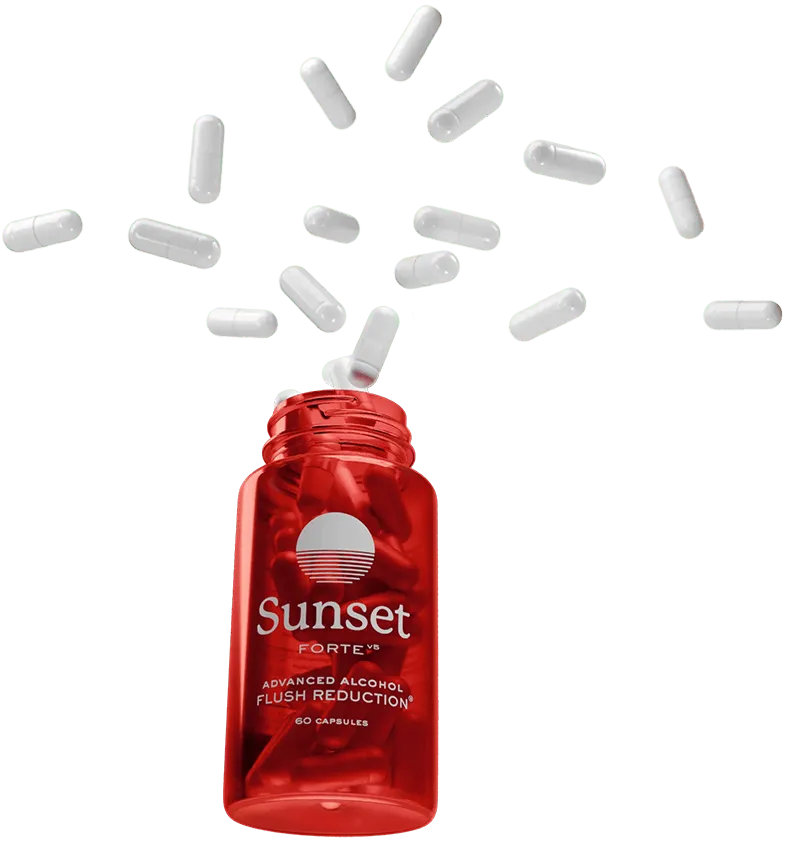
If you do still drink, Sunset Alcohol Flush Support takes the oral route — capsules with DHM, NAC and B vitamins formulated to support your body's natural acetaldehyde processing, rather than relying on absorption through the skin.
The bottom line
Asian flush patches are a genuinely appealing idea: discreet, easy, no pills to swallow. But the skin is a stubborn barrier, the doses involved are large, and there's little evidence patches deliver enough to make a real difference — on top of the practical hassles.
If you're looking for support with flushing, a well-formulated oral option is a more sensible starting point. And whatever you choose, the surest protection is still moderating how much you drink — because the flush, ultimately, is your body flagging a toxin it's struggling to clear.
Enjoy your social life again — get Sunset Alcohol Flush Support for
33% off while stocks last!
What's inside?
Sunset Forte uses a carefully formulated blend of Glutathione, Dihydromyricetin, Cysteine, L-Theanine, & B Vitamins to support natural acetaldehyde processing and a clearer, less-flushed look.
Learn more
94% of people who try Sunset are satisfied.