Why Does Champagne Give Me a Headache?

- Why does champagne give me a headache?
- Other symptoms besides the champagne headache
- How to avoid champagne headaches
Share this article
Copy and paste this link
Does a glass or two of champagne leave your head pounding? If bubbly is your celebration drink but it triggers a headache that puts a damper on the fun, you're in good company. Champagne adds sparkle to the occasion — the throbbing afterwards, less so.
The good news: with a few simple strategies you can cut down champagne headaches and enjoy your bubbly from the first toast to the last. And if your reaction goes beyond a headache — a red, hot face, a racing heart — that's a different mechanism (the alcohol flush reaction), and we'll point you to the right help for that too.
Below we'll unpack why champagne seems to go straight to your head faster than other drinks, and what actually helps.
Why Does Champagne Give Me a Headache?
Short answer: blame the bubbles.
Champagne isn't especially high in alcohol, yet it tends to hit faster and harder than a still drink — and the reason is the carbonation. The carbon dioxide in those bubbles raises the pressure in your stomach and speeds alcohol through the stomach lining into your bloodstream, so your blood-alcohol level climbs faster than it would with a flat drink. Researchers at the University of Surrey demonstrated this neatly: volunteers who drank fizzy champagne had measurably higher blood-alcohol after five minutes than those who drank the same champagne gone flat.
As sommelier Marco Castelanelli has explained, the CO2 in sparkling wines changes how quickly alcohol moves into the bloodstream, which is why a couple of glasses can leave you feeling woozy and tipsy faster than expected — and set you up for a bigger hangover.
The carbonation is what sets champagne apart from a still drink — it speeds the whole process up.
That faster, higher spike in blood alcohol is the real engine behind the champagne headache. Stack the usual suspects on top and you've got a perfect storm:
- Dehydration. Alcohol is a diuretic, so you lose fluid faster than you replace it — a classic headache trigger.
- Sugar. Champagne and sweeter sparkling wines can carry a fair bit of sugar, and the blood-sugar spike-and-dip can add to that rough feeling.
- Histamines. Like other wines, sparkling wine contains histamines that can dilate blood vessels in sensitive people — more on that in our guide to alcohol intolerance and sensitivities.
And the thing people most often blame? Sulfites — which mostly aren't the culprit. As headache specialist Dr. Frederick Freitag has long maintained, sulfites can trigger allergy and asthma symptoms but don't cause headaches (we go deeper in our piece on sulfites in your drink). So if champagne reliably gives you a headache, the bubbles and the booze are far likelier suspects than the sulfites — and that holds true even after only a small amount.
Other Symptoms You May Feel Besides the Champagne Headache
Because champagne is absorbed so quickly, its after-effects tend to arrive fast. Alongside the headache, you might notice:
- Nausea and dizziness
- A stuffy nose
- Feeling hot or flushed
- Drowsiness and fatigue
- For some people, red facial flushing — the alcohol flush reaction
If that last one sounds familiar — your face going red and hot when you drink — it's worth understanding on its own, because it points to a different cause than the bubbles. We come back to that at the end.
For a quick visual explainer, this video from the GQ Hangover Lab covers exactly why those bubbles cause trouble. Host Dr. Keller Wortham breaks down how the carbonation in champagne ramps up your hangover — and suggests switching to a still red or white wine after your first glass to take the fizz out of the equation:
How to Avoid Champagne Headaches
The surest way to avoid a champagne headache is not to drink — but for most of us, skipping the New Year's toast or the birthday mimosa isn't the plan. Since the problem is mostly about how fast the alcohol lands, the fixes are about slowing that down.
Alternate with water
Have a glass of water for every glass of fizz. Alcohol's diuretic effect dehydrates you, and the bubbles get you there faster — so matching each glass with water (plus one more before bed) genuinely helps.
Don't drink it on an empty stomach
An empty stomach plus carbonation is the fastest possible route into your bloodstream. A light meal — some complex carbs and protein — before the first pour slows absorption and softens the blood-sugar swing.
Pace yourself
The whole champagne problem is speed, so sipping rather than knocking it back matters more here than with most drinks. A rough rule of thumb: no more than one drink an hour.
If a headache does land anyway, the boring fixes are the reliable ones — water, rest and time. (Be cautious about reaching for pain relievers alongside alcohol; some can irritate the stomach or stress the liver, so check what's appropriate for you.)
The Bottom Line on Champagne Headaches
So, why does champagne give you a headache? More than anything, it's the bubbles: the carbonation speeds alcohol into your bloodstream, so you feel it faster and the after-effects hit harder — and champagne is all too easy to overdrink. Water, food and pacing are your best defences.
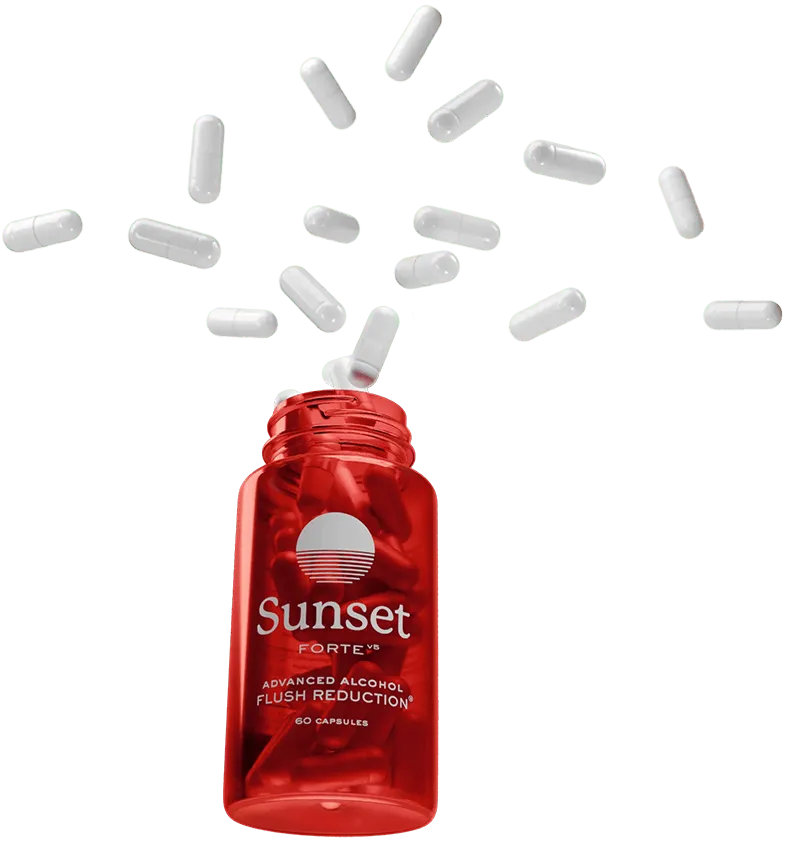
One honest distinction worth drawing, though. If your champagne reaction is mainly a headache, it's the bubbles and dehydration, and the tips above are what help. But if you also go red and hot in the face, get a racing heart, or feel unwell after even a small amount, that's a different thing entirely — the alcohol flush reaction, caused by an ALDH2 enzyme deficiency rather than the carbonation. It shows up with any alcohol, not just champagne, and it's the acetaldehyde build-up behind it that Sunset Alcohol Flush Support is formulated to help your body clear. So for an ordinary bubbly headache, reach for water; if it's the flush you're dealing with, that's where we can genuinely help.
Enjoy your social life again — get Sunset Alcohol Flush Support for
33% off while stocks last!
What's inside?
Sunset Forte uses a carefully formulated blend of Glutathione, Dihydromyricetin, Cysteine, L-Theanine, & B Vitamins to support natural acetaldehyde processing and a clearer, less-flushed look.
Learn more
94% of people who try Sunset are satisfied.