Why Does Alcohol Make You Hot? The Science Behind Feeling Flushed

⏱️ TL:DR ∙ Article in 20s
Alcohol makes you feel hot through vasodilation — it widens the blood vessels near your skin, so warm blood rushes to the surface and your skin's heat sensors register a flush of warmth. The twist: that same process sheds heat from your core, so your core temperature actually drops — which is why drinking to "warm up" in the cold is a real hypothermia risk. For some, it's the more intense flush reaction, driven by acetaldehyde. To feel cooler: drink slower and less, go lower-strength, and sip water.
- The main reason: your blood vessels open up
- The twist: you feel hot, but you're losing heat
- When the heat is the flush reaction
- Why drinking also makes you sweat
- How to feel cooler when you drink
- When to pay attention — and the bottom line
Share this article
Copy and paste this link
A few drinks in and your face is glowing, your skin's warm to the touch, maybe you're peeling off a layer — as if someone quietly turned up the thermostat. It's one of the most familiar feelings of a night out.
The surprising part? That warmth is real, but it's also a kind of illusion: while you feel hotter, your body is quietly getting colder. Here's what's actually happening.
The main reason: your blood vessels open up
The warmth comes down to one word: vasodilation. Alcohol relaxes and widens the small blood vessels just under your skin, so a rush of warm blood flows from your core to the surface — and the heat sensors in your skin register it as a flush of warmth.
Cleveland Clinic dermatologist Dr. Melissa Piliang puts the mechanism plainly: alcohol gets into the cells of your blood vessels and makes them dilate. "This reddens your skin and can make you feel warm." It's the same process behind the red face so many people get when they drink.
The twist: you feel hot, but you're losing heat
Here's the counterintuitive bit. All that warm blood rushing to your skin doesn't create heat — it carries your core's heat to the surface, where it escapes into the air. So even as your skin feels warm, your core body temperature is actually dropping.
Physiology professor Michael Tipton explains the feeling: "This increases skin temperature and makes you feel warm." But by flushing and sweating, he notes, you're delivering heat to the skin and losing it from your core to the environment. Alcohol also blunts shivering and dulls the brain's thermostat, so your body defends its temperature less well.
This is why the cosy "tot of brandy to warm up" is a dangerous myth. A paradoxical feeling of warmth alongside falling body temperature has been documented for over a century, and it makes alcohol a genuine risk factor for hypothermia in the cold — exactly when people feel warm enough to shed a jacket or stay out longer.
When the heat is the flush reaction
For some people the warmth isn't mild — it's an intense, prickly heat with a deep-red face after barely a drink. That's the alcohol flush reaction, and it runs on the same vasodilation, just turned up.
The culprit is acetaldehyde, the toxic byproduct your body makes from alcohol. As consultant dermatologist Dr. Phillips notes, "When we metabolise alcohol it is converted into acetaldehyde." People with an ALDH2 deficiency — common across East Asian populations — clear it slowly, so it builds up and becomes a potent trigger of flushing, dilating vessels hard and releasing histamine.
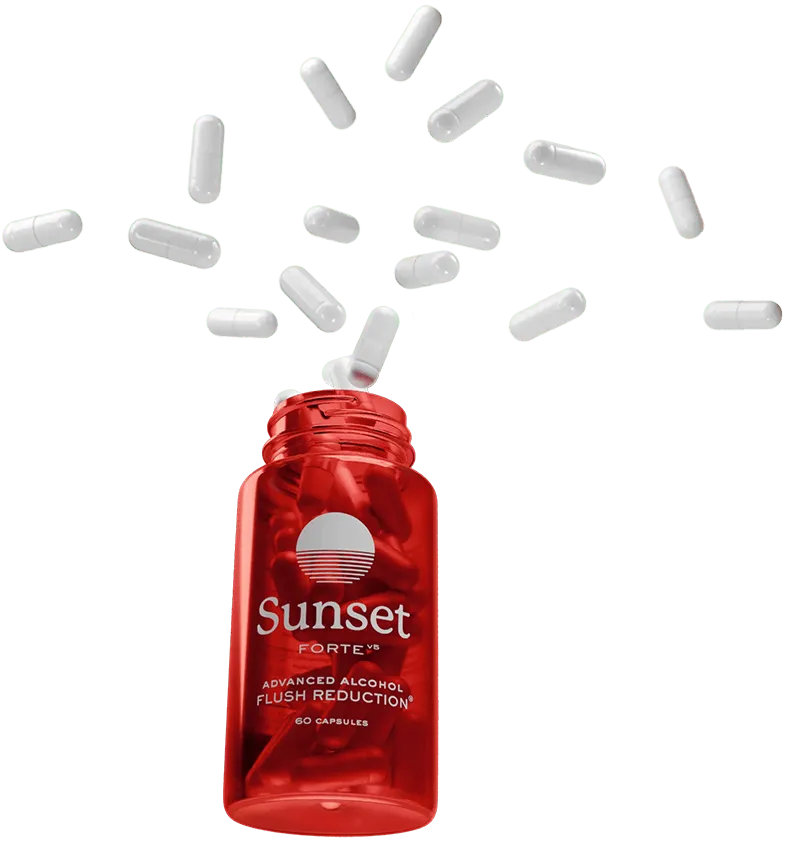
If that's you, the only real lever is drinking less — and it's worth knowing the flush is a genuine health signal, not just a cosmetic one (we cover the cancer-risk side separately). Sunset Alcohol Flush Support is formulated with DHM, NAC and B vitamins to support your body's natural acetaldehyde processing — aimed at that flush mechanism, not a way to drink more, and no substitute for moderation.
Why drinking also makes you sweat
Sweating travels with the heat for the same underlying reason. As warm blood reaches your skin and your skin temperature climbs, your body does what it always does to shed heat: it sweats, so evaporation can cool you down. It's thermoregulation working exactly as designed — just triggered by alcohol rather than a hot day.
It can also show up hours later as night sweats. As your blood alcohol falls back toward zero, your system rebounds and your temperature regulation wobbles, which is why you can wake up clammy after an evening of drinking.
How to feel cooler when you drink
You can't switch off your own biology, but you can keep the effect modest — and the levers are the familiar ones.
- Slow down and drink less. The more alcohol in your system at once, the stronger the vasodilation and the hotter you'll feel. Pace is your main control.
- Go lower-strength. A lower-ABV drink means less alcohol doing the dilating, so less heat at the surface.
- Cool from the outside. Sip water, step into fresh air, and dress in layers you can shed — practical relief while the alcohol clears.
When to pay attention — and the bottom line
Feeling warm after a drink is usually harmless in a comfortable room. But take it seriously in two situations: in the cold, where that false warmth masks real heat loss, and when the reaction is severe — intense flushing with headache, nausea or a pounding heart from very little alcohol is worth a conversation with your doctor.
The short version: alcohol makes you feel hot by opening your blood vessels and rushing warm blood to your skin — but that same process is shedding your core heat, not adding to it. Enjoy the glow in the warmth if you like, respect it in the cold, and if the heat is really the flush reaction, the kindest fix is simply less alcohol.
Enjoy your social life again — get Sunset Alcohol Flush Support for
33% off while stocks last!
What's inside?
Sunset Forte uses a carefully formulated blend of Glutathione, Dihydromyricetin, Cysteine, L-Theanine, & B Vitamins to support natural acetaldehyde processing and a clearer, less-flushed look.
Learn more
94% of people who try Sunset are satisfied.