Why Do I Get Drunk So Fast? What Actually Speeds It Up

⏱️ TL:DR ∙ Article in 20s
Getting drunk fast comes down to your blood alcohol concentration (BAC) — how fast alcohol enters your blood versus how fast your liver clears it (a fixed ~1 drink per hour, which nothing speeds up). Anything that quickens the "in" side spikes you: an empty stomach, drinking quickly, high-strength drinks, a smaller frame or less body water, age, some medications, and diet mixers. And if it's mainly a red face, racing heart and headache after barely a drink, that may not be drunkenness at all — it's the flush reaction. To stay in control: eat first, pace yourself, and alternate with water.
- It comes down to your blood alcohol concentration
- You're drinking on an empty stomach
- You're drinking quickly — or drinking strong
- Your body size, composition and sex
- Your age, tolerance and medications
- The mixer question: bubbles and diet soda
- Or maybe you're not actually drunk
- When to look closer — and how to pace yourself
Share this article
Copy and paste this link
Two drinks in and the room has started to tilt — yet the friend next to you, matching you glass for glass, looks completely unbothered. Same drinks, same night, totally different state. What gives?
It nearly always comes down to a single number, and a handful of things that make that number climb faster for you than for them.
It comes down to your blood alcohol concentration
How drunk you feel tracks your blood alcohol concentration (BAC) — how much alcohol is in your bloodstream at a given moment. And BAC is really a race between two things: how fast alcohol gets in, and how fast your body clears it out.
The clearing side is fixed. Your liver processes roughly one standard drink per hour, and nothing reliably speeds that up — not coffee, not a cold shower, not water. So if alcohol enters your blood faster than that, it stacks up, your BAC spikes, and you feel it. Everything below is just a different way of winning — or losing — that race.
You're drinking on an empty stomach
This is the big one, and the easiest to fix. Most alcohol is absorbed in your small intestine, not your stomach — so anything that slows the trip from one to the other slows your buzz.
Food does exactly that. A meal keeps the valve at the bottom of your stomach closed while digestion happens, holding the alcohol back so it trickles through rather than flooding in. On an empty stomach there's nothing to slow it, so it reaches your bloodstream fast. Protein, fat and fibre slow things most; a few crackers is better than nothing.
You're drinking quickly — or drinking strong
Since your liver only clears about a drink an hour, pace is everything. Knock back two or three in quick succession — shots especially — and you've poured in far more than you can process, so it pools in your blood. Sipping the same drinks over a couple of hours gives your liver a fighting chance to keep up.
What's in the glass matters just as much. A high-ABV spirit delivers far more alcohol per sip than a beer or a low-alcohol drink, so the same number of "drinks" can mean wildly different doses.
Your body size, composition and sex
Alcohol spreads through the water in your body, so the more body water you have, the more diluted it gets. A larger person, and someone with more muscle (which holds far more water than fat), ends up with a lower BAC from the same drink than someone smaller or with a higher body-fat percentage.
This is also why, on average, women reach higher BACs than men from an identical drink: women tend to carry proportionally less body water, and have less of the stomach enzyme that begins breaking alcohol down before it's absorbed. Same drink, genuinely different result.
Your age, tolerance and medications
If you've noticed alcohol hitting harder than it used to, age is a likely culprit. As we get older we lose lean muscle and the body water that comes with it, and the liver slows down. As Cleveland Clinic geriatrician Dr. Koncilja puts it, with less muscle "a higher concentration of alcohol remains in the bloodstream."
Tolerance swings it the other way: drink rarely and the same amount will hit harder than it did when you drank often. And medications are a quiet, common cause — many interact with alcohol and can leave you feeling drunk on far less than usual. The NIAAA keeps a list worth checking, and if you've just started something new, ask your doctor before drinking.
The mixer question: bubbles and diet soda
Two drink-related effects get talked about a lot — one better supported than the other. The sturdier finding is about diet mixers: in a controlled study, vodka with a diet mixer produced a peak breath-alcohol level about 18% higher than the same vodka with a regular, sugary one (0.091 vs 0.077).
Researcher Dr. Dennis Thombs explains it simply: "the sugar in regular soda slows down the rate of alcohol absorption." Take the sugar away and nothing holds the alcohol back.
Carbonation itself is shakier. The theory is that bubbles speed your stomach emptying, but the studies are small and mixed — New York gastroenterologist Dr. Anthony Celifarco says of the mechanism, "I don't think that's been proven." If bubbles do anything, it's likely deliver the alcohol a little faster, not get you more drunk overall.
Or maybe you're not actually drunk
Here's a twist worth knowing: if "getting drunk fast" means your face goes red, your heart races and your head pounds after barely a drink, that may not be intoxication at all. It can be the alcohol flush reaction — a build-up of acetaldehyde, not alcohol, in people whose bodies can't clear it efficiently.
The two feel different once you know what to look for. Genuine drunkenness is slurring, wobbling and slowed reactions. The flush reaction is feeling hot, flushed, a thumping headache or nausea — sometimes mistaken for being drunk, but it's a chemical reaction, not impairment.
When to look closer — and how to pace yourself
A one-off fast night usually has a simple explanation: you skipped dinner, drank quickly, or chose something strong.
But if you've suddenly started getting drunk far faster than you used to, and it's sticking around, that's worth attention — a new medication is the usual suspect, and rarely it can reflect a change in liver health. If it's a real, persistent shift, see a doctor. The same goes if a tiny amount triggers the flush-type symptoms above — our guide to sudden alcohol intolerance covers that.
To keep the night in your control: eat first, alternate drinks with water, sip rather than shoot, and favour lower-strength drinks. None of it changes how fast your liver works — but all of it slows how fast the alcohol arrives, which is the part you can actually steer.
Enjoy your social life again — get Sunset Alcohol Flush Support for
33% off while stocks last!
What's inside?
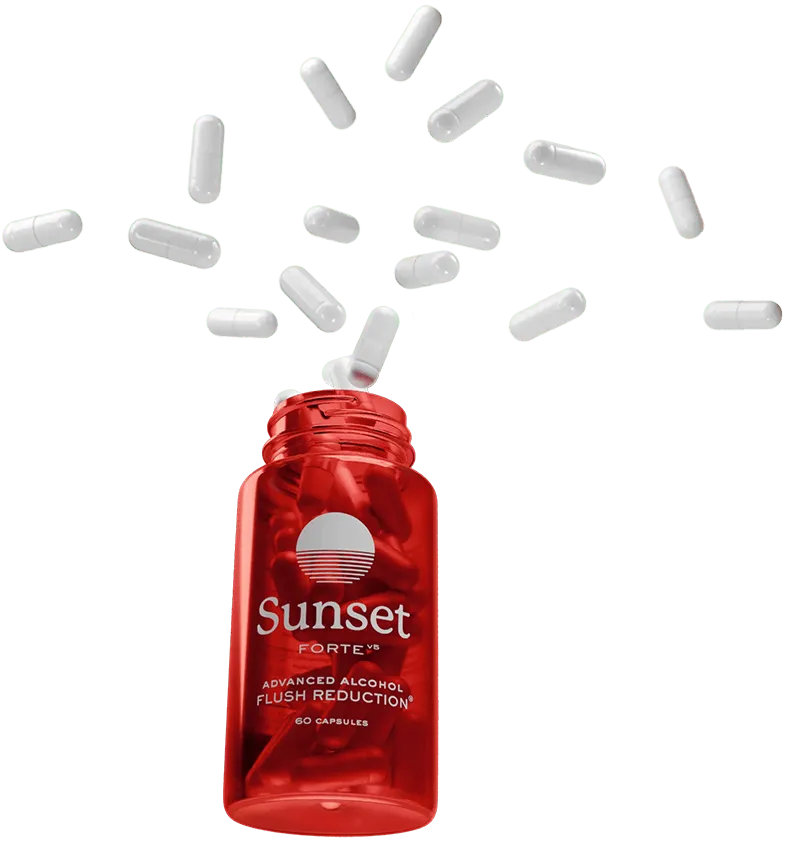
Sunset Forte uses a carefully formulated blend of Glutathione, Dihydromyricetin, Cysteine, L-Theanine, & B Vitamins to support natural acetaldehyde processing and a clearer, less-flushed look.
Learn more
94% of people who try Sunset are satisfied.