How to Cover Asian Flush With Makeup: A Colour-Correcting Guide

Share this article
Copy and paste this link
If your cheeks light up after a drink, you've probably wished you could just turn it off — especially at a wedding, a work function, or anywhere a camera is pointed at you. Makeup can genuinely help with that. With a bit of colour theory, you can even out the look of flush redness so it's far less noticeable.
But it's worth being clear about what makeup is doing before we get into the how. Covering the redness changes how your skin looks. It does nothing about what's actually happening underneath — and with the alcohol flush reaction, what's happening underneath is the part that matters. So think of this as a confidence tool, not a fix. (Makeup is just one of the things people reach for; we take an honest look at the rest in our guide to DIY Asian flush cures.)
First, why your face turns red
When you drink, your body breaks alcohol down into acetaldehyde, then normally clears it using an enzyme called ALDH2. If you have the common genetic variant behind Asian flush, that enzyme works slowly, acetaldehyde builds up, your blood vessels widen, and your skin flushes warm and red. It's a metabolic reaction, not a skin condition — which is exactly why a product applied to the skin can change the colour you see but not the cause. If you want the full picture, our complete guide to Asian flush walks through the biology in detail.
Makeup works on the top layer. The flush reaction is happening underneath it.
The science of colour correction: why green cancels red
Here's the genuinely useful part. Covering redness well isn't about piling on thick foundation until nothing shows through — that tends to look heavy and cakey. The smarter approach is colour correction, and it comes straight out of basic colour theory.
On the colour wheel, every colour sits opposite its "complementary" colour, and complementary colours cancel each other out. Red sits directly opposite green. So a thin layer of green-tinted product laid over a red area neutralises the redness, leaving a more even base for the rest of your makeup. The American Academy of Dermatology recommends exactly this for people with redness-prone skin: a green-tinted concealer to camouflage redness, followed by your normal skin-tone makeup.
A little goes a long way — the goal is neutral, not noticeably green.
New York makeup artist and educator Haley Kim walks through the do's and don'ts of colour correcting for beginners in this short tutorial:
Tutorial by Haley Kim on YouTube.
How to cover flush redness, step by step
The technique below is the one professional makeup artists and dermatologists tend to recommend for redness. The single most common mistake is using too much green — you want the faintest veil, blended out, not a visible green patch.
Thin layers, well blended, beat one heavy coat every time.
A few details that make the difference:
- Prep matters more than people think. The AAD notes that gentle cleansing, moisturising, and daily sunscreen give makeup a smoother, more comfortable base to sit on — and reduce the dryness that makes products look patchy.
- Correct only where you're red. Cheeks, nose, and chin are the usual hotspots. There's no need to coat your whole face in green.
- Build in sheer layers. A strategic corrector plus buildable foundation looks far more natural than one thick layer everywhere.
- Be kind to sensitive skin. The National Rosacea Society suggests water-soluble, oil- and fragrance-free, non-abrasive products for redness-prone skin, since harsh formulas can make matters worse.
What to look for in a product
You don't need a specific brand — you need the right type of product for your skin and the look you want. For full transparency: we don't earn a commission on anything mentioned below. These are simply common, widely available examples of each category.
Green colour-correcting creams and concealers
These are the workhorses for redness — a green or green-tinted cream applied in a thin layer before foundation. Redness-neutralising correcting creams (for example, IT Cosmetics' Bye Bye Redness) are popular because a little covers a lot. Look for buildable coverage and a texture that blends easily rather than sitting on top of the skin.
Colour-correcting primers
If you prefer something lighter, a green-tinted primer (such as Algenist's REVEAL Colour Correcting Primer) sits under your foundation, knocking back redness while giving the rest of your makeup something to grip. Primers feel lighter than a dedicated corrector, which suits people who don't want a heavy base.
Anti-redness BB creams and tinted moisturisers
An anti-redness BB cream (like L'Oréal's Anti-Redness BB) can double as a light, do-it-all base. Results vary a lot with skin tone, so this is one to test on the back of your hand — or your jaw — before committing to your whole face.
A soothing facial spray for the warm feeling
Flush isn't only about colour — there's often a hot, prickly sensation too. A thermal spring water spray (Eau Thermale Avène is the best known) is essentially mineral water in a fine mist; it won't change the reaction, but a light spritz can feel cooling and refreshing after a bad flush. Handy in a bag for a night out, just don't expect it to do anything beyond comfort.
Look after the skin underneath, too
Whatever you put on top, redness-prone skin does better with a gentle routine. Dermatology bodies broadly agree on the basics: wash with lukewarm water and your fingertips rather than scrubbing, skip exfoliating scrubs and harsh toners, use a fragrance-free moisturiser, and wear a broad-spectrum sunscreen every day (mineral or tinted-mineral formulas tend to be best tolerated). Calming ingredients like niacinamide can help some people, while fragrance and harsh alcohols are common irritants worth avoiding. None of this stops alcohol flush — but it keeps your skin in better shape, which makes any makeup you do wear look better.
The honest bottom line
Makeup is a brilliant confidence tool. If colour-correcting helps you feel comfortable at a wedding or in a photo, that's a completely legitimate reason to use it, and now you know how to do it well.
There’s an irony worth noting: while you’re toning your flush down, the Igari “drunk blush” makeup trend has others painting a flushed glow on deliberately.
Just keep the bigger picture in view. Concealer changes how your skin looks for an evening; it doesn't change the reaction happening underneath, and it doesn't make drinking any safer for someone who flushes. The flush is feedback — and the only proven way to reduce the long-term health risks tied to it is to drink less, or not at all. If your reactions are frequent or severe, it's worth a conversation with a clinician rather than a heavier coat of foundation.
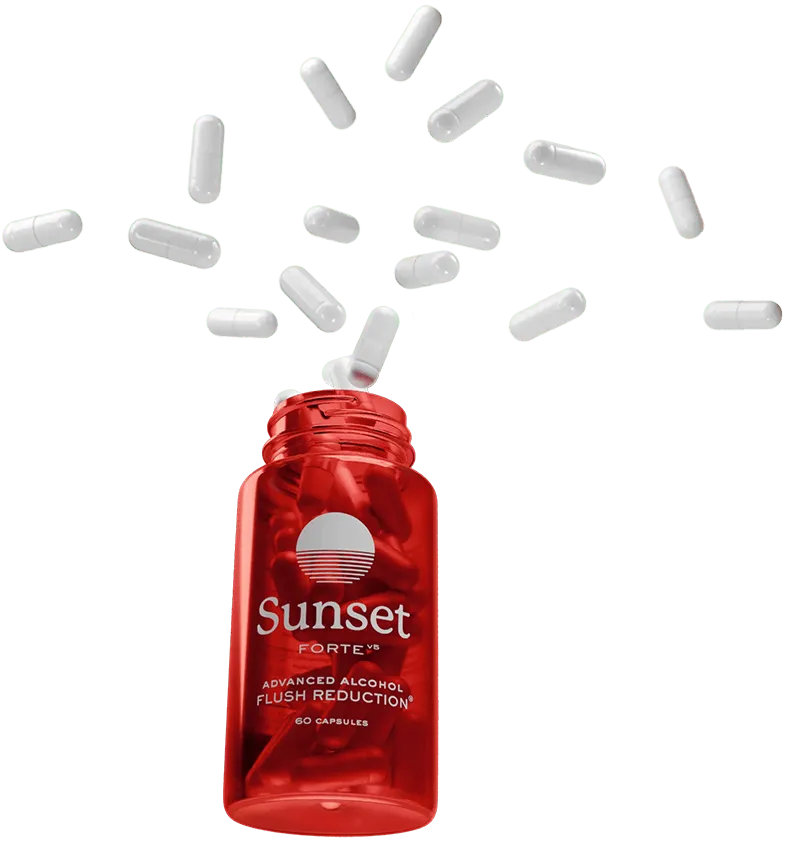
This is also where Sunset fits in. It's formulated around ingredients — including N-acetylcysteine (NAC) and S-Acetyl Glutathione — that support your body's natural acetaldehyde-clearing pathways, which is a different thing from painting over the result. To be straight with you: Sunset is a supplement that supports acetaldehyde metabolism, not a cure for the ALDH2 variant and not a reason to drink more. Many people simply find it makes a flush-prone night more comfortable. Makeup hides the colour; the point of Sunset is to support what's going on underneath.
Have a colour-correcting trick or product that's worked for your flush? We'd genuinely like to hear it — send us a message and we may add it here to help other readers.
Enjoy your social life again — get Sunset Alcohol Flush Support for
33% off while stocks last!
What's inside?
Sunset Forte uses a carefully formulated blend of Glutathione, Dihydromyricetin, Cysteine, L-Theanine, & B Vitamins to support natural acetaldehyde processing and a clearer, less-flushed look.
Learn more
94% of people who try Sunset are satisfied.